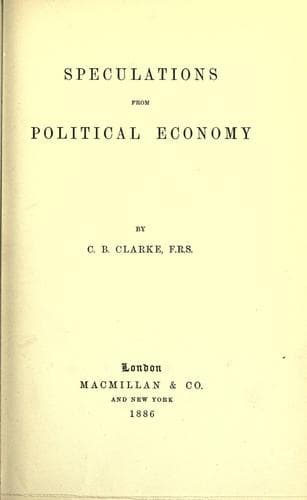
Speculations from Political EconomyClarke, Charles Baron
General
Speculations from Political Economy
Clarke, Charles Baron
Economics
A prevalent idea is that the land is not highly farmed enough, and
that the land of England might be made to yield much more, and that
Government is to cause this to be done. It is most unfortunate to raise
this theory at the moment when land is "down," i.e. when produce is
cheap, labour expensive. Every farmer knows that the only way to meet
these conditions is to farm "lower." In a south country farm the farmer
will sow much less corn, and try to keep more sheep. In the Western
States of America, where produce is very cheap, labour very dear, the
"lowness" of the farming is always abused by the English traveller
(who thus shows that he knows nothing about either farming or political
economy). A farmer, twenty-five years ago, took a very large and fine
corn farm: it had been worked on the five-course system, i.e. three
white crops in five years; the farmer made a careful calculation whether
a four-course husbandry, i.e. two white crops in four years, would not
be more profitable; it appeared to come to exactly the same thing. At
this juncture a rise of a shilling a week in wages took place; this gave
a clear advantage to the four-course, and the farm was at once worked
round to the four course shift. In this simple case a small rise in
wages brought about a considerable diminution in gross produce, while
the loss to the farmer was small. The remarks in this section have been
directed to the case, common in the South of England, where there has
been within the last twelve years a fall of rent from 25 to 50 per cent.
In pasture farms, in rich land, and in potato farms (wherein you can
keep one-sixth the land in potatoes), the fall in rent has been much
less--sometimes inappreciable.
But, some person may urge, if Government interferes, and compels the
farmer to farm higher than he wishes to himself, the gross produce
will be more, and the employment for labourers will be at the same time
better. True, and this is the quintessence of Protection. The whole
point of Free Trade is to allow capital to be employed where it is most
profitable: high farming is only to be preferred (both for individual
and nation) to low when it is the more profitable. Capital that cannot
be employed to ordinary trade profit on the land must be transferred to
other industries where it will earn the ordinary rate of trade profit;
or, if there is no trade yielding such profit ready to absorb it in
England, the capital must go to the United States or New Zealand and
earn an increased profit. As to the labourers, they must follow the
capital; or they may starve in England leaving few progeny, while the
well-fed labourers of the Western States of America and New Zealand
leave large families: this will do instead of emigration.
Public-domain text, read in full here on John Shaqi.
Reviews
Reviews
No reviews yet
Be the first to share your thoughts on this work.
Join the Discussion
Join the discussion
Sign in to leave a comment or review.
Sign InorCreate an account