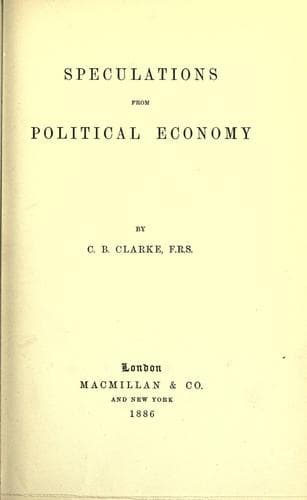
Speculations from Political EconomyClarke, Charles Baron
General
Speculations from Political Economy
Clarke, Charles Baron
Economics
It is to be noted that great improvements in farming, especially in
machinery, have been effected in the last thirty years, largely by the
operation of the All England and County Agricultural Societies. I
note further that the people who abuse the farmers for bad farming
and clamour for Government interference to promote high farming,
conspicuously refrain from supporting these agricultural societies.
6. FREE TRADE IN RAILWAYS.
Government might monopolise the retailing of tea in England. At present,
in a country town like Exeter or Canterbury, there may be fifty
grocers selling tea. In their competition they lay out a good deal in
advertisement and handsome shop fronts in the most expensive streets;
they keep (the fifty between them) many more hands than are necessary
to retail the tea. All this outlay has to come out of the consumer.
Government would buy pure tea first-hand in large quantities cheap; a
few trustworthy highly-paid officials would test it, value it, and see
it done up in sealed packages of sizes from 16 lbs. down to 2 oz.: these
might be sold in an odd room attached to the Post Office in each town
and village. There can be little doubt but that a saving in capital
and labour would thus be effected, while the public would get the tea
cheaper and purer than at present. The 2 oz. purchaser, in particular,
would pay a good deal less for 2 oz. of real tea than she pays now for 2
oz. of rubbish.
Or,--Government might hand over the tea-retailing of Canterbury and five
miles round to a company as a monopoly: the state of things would be
something like what we experience in the large stores now: the public
would get their tea probably cheaper (quality considered) than at
present; the company would make a large profit on their capital. If
Government sanctioned two tea-retailing companies at Canterbury, these
would probably make a less rate of profit: though, after the first heat
of fight was over, they would probably agree to sell the same tea at the
same (profitable) rates, and the consumers would gain little out of so
restricted a competition. If a new company were to apply for a private
Act to enable them to retail tea at Canterbury, the old company would
show Parliament that themselves sufficed to satisfy the requirements of
the public.
Public-domain text, read in full here on John Shaqi.
Reviews
Reviews
No reviews yet
Be the first to share your thoughts on this work.
Join the Discussion
Join the discussion
Sign in to leave a comment or review.
Sign InorCreate an account