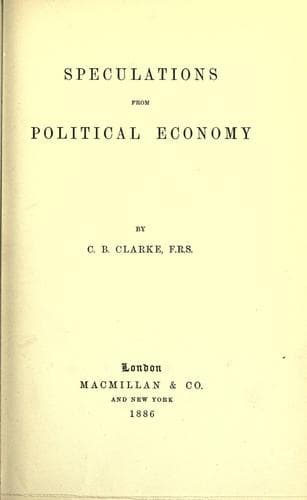
Speculations from Political EconomyClarke, Charles Baron
General
Speculations from Political Economy
Clarke, Charles Baron
Economics
A great deal of the opposition between rival companies has been from
their point of view an error, as they have subsequently discovered for
themselves. When the Great Western Company first opened their station
at Basingstoke there was war between them and the South-Western, who
thought all their London West-End passengers would transfer themselves
to the Great Western at Basingstoke in order to avoid a cab drive from
Waterloo to Paddington. Some passengers do so transfer themselves. But
_via_ Basingstoke a fine trade sprang up between the south of England
and the Oxford and Leamington route, which far more than compensated
the South-Western Company for the London passengers they lost at
Basingstoke. So in a very few years there was peace at Basingstoke, and
a through-carriage daily from Birkenhead to Southampton. I think it
is impossible to estimate how much one railway company profits by the
facilities afforded by all the surrounding companies. The loss at a
limited number of competing termini is seen; the gain in the local and
cross-country traffic is not.
I propose Free Trade in Railways. I mean that any person or company
shall be free to make a railway wherever they please. They will have,
before commencing the line, to lodge with the Board of Trade the cost of
the land they take as valued in the National Rate Book, with the 30
per cent for compulsory purchase. They will not have to lodge the money
where they have come to terms with the owner; and the Board of Trade
will allow them to construct the line in reasonable sections. Having
lodged their money, the company (or private speculator) will only have
to go to work under the (amended) Lands Clauses Consolidation Act.
If this scheme were sanctioned we should have in the course of the
next twenty years, _as I estimate_, £100,000,000 additional invested in
England profitably--not under Government pressure, but by business men
to get interest. Even where the new lines paid little interest we should
get the accommodation of the public. We should have no big village
without its railway; and we should have a great extension of private
sidings. On the eastern half of England we might get a great number of
narrow gauge steam trams running along the present trunk roads. (Suppose
a steam tram from London to York by the Royston route, going through
all the towns, running trams an hour apart all day, going eight miles an
hour through the towns, sixteen or twenty miles an hour in the country,
taking up and setting down everywhere, would it not pay?)
The only objection to Free Trade in railways is that it would injure the
existing railway monopoly. Under this principle no monopoly ever would
have been or ever will be put down. But I believe the existing great
companies would very generally gain by Free Trade in railways.
Public-domain text, read in full here on John Shaqi.
Reviews
Reviews
No reviews yet
Be the first to share your thoughts on this work.
Join the Discussion
Join the discussion
Sign in to leave a comment or review.
Sign InorCreate an account