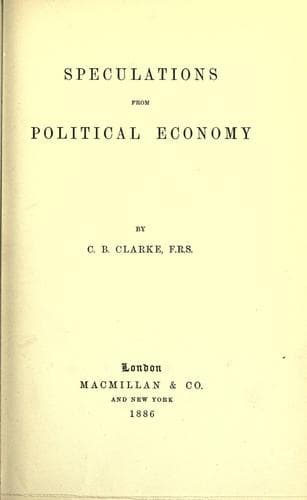
Speculations from Political EconomyClarke, Charles Baron
General
Speculations from Political Economy
Clarke, Charles Baron
Economics
We see thus that in the case of the land tax, as we saw above of the
tithe, and as is also the case in any tax permanently on, a disturbance
of the existing taxation is inequitable. This point is so much
misunderstood that I will give one more illustration.
I am purchasing an estate, intending to farm it myself. There are 400
acres of land, and I reckon the land worth 30s. an acre. I am willing
to give twenty-five years' purchase. I find the tithe is £100 a year. I
therefore propose to give twenty-five times £500 = £12,500 for the land.
But before the bargain is completed I find that the tithe is £150 a
year. I at once sink my bid to twenty-five times £450 = £11,250, and buy
the estate at that price. The next year some financier "equalises" the
tithe, and my tithe is reduced to £100. Is it not clear that, by the
equalisation, I pocket £1250, and somebody else loses it?
New taxes when imposed should be "equal," as far as can be arranged.
When a legacy duty was imposed, it would have been just to impose a
succession duty also. But, after the legacy duty had been imposed twenty
years with no succession duty, it was similarly inequitable to put on a
succession duty; for quantities of land had been bought in the interval
of twenty years at a slightly higher price than if there had been no
legacy duty, because there was no succession duty.
The proposal for "equalising" taxes is usually put forward in order to
get a somewhat larger gross income from the taxes equalised, or as a
political cry. Nothing can be more absurd than the cry that the land is
over-burdened in comparison with other property. There is no comparison
in the case. Some land being tithe free, some land tax free, some nearly
rate free, those persons who do not trouble themselves to master the
political economy may yet be satisfied that the "burdens" of the land
affect neither the farmer, the labourer, nor the produce of the farm;
the burdens fall _wholly_ on the landlord (a farmer with a lease being,
as above shown, a part landlord). The efforts of some Conservative
orators for the last twenty-five years to prove the contrary are
erroneous in the reasoning; or I should say, much of the "reasoning"
does not hang together at all. Without formally refuting these efforts,
I repeat that they are fully refuted in the result.
Public-domain text, read in full here on John Shaqi.
Reviews
Reviews
No reviews yet
Be the first to share your thoughts on this work.
Join the Discussion
Join the discussion
Sign in to leave a comment or review.
Sign InorCreate an account