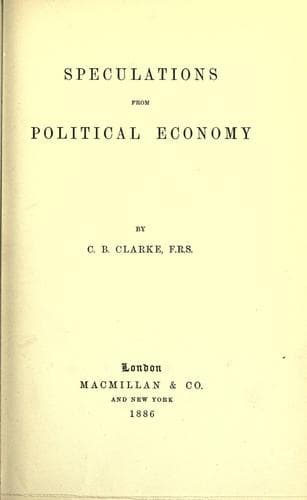
Speculations from Political EconomyClarke, Charles Baron
General
Speculations from Political Economy
Clarke, Charles Baron
Economics
It is therefore that I have insisted above that, in order to carry out
the proposed ransom of the land, a new Property Rate, separate from
and in addition to all other taxes, is necessary. Though the manner of
levying a National Property Rate which I have proposed lends itself very
nicely to getting in such an extra tax, it is not at all on that ground
that I have suggested the new manner of levy. The object of the new
manner of levy and the sycophants is to get every piece of land in the
country into the hands of that man who can make most of it; including
herein as an important item the cheap and easy acquisition of land
required for Government, public and commercial (railway, etc.)
enterprises.
In any great reform of our whole system of taxation a disturbance of
existing interests must take place. Though I would not disturb existing
interests for the sake of mere equalisation or official beauty of work,
I would not let the fear of disturbing private interests stand in the
way of any real or important reform. The introduction of Universal
Free Trade and the abolition of all duties would be accompanied by a
disturbance; but, as far as I can see, no one would lose, while many
would gain enormously.
On the same ground of equality of new taxation I should propose to
replace the amount now levied in duties mainly by an income tax. That
is a perfectly level tax; the idea that temporary incomes ought to pay a
lower rate is fallacious. We are all agreed to tax the poor at a _lower_
rate; we have now a section of advanced Radicals proposing to tax the
rich at a higher rate. One present candidate for Parliament is even
willing to tax people of £100,000 a year and upwards at nineteen
shillings in the pound. This of course, or anything approaching it, is
unpractical. But I have suggested above, as a rough plan in accordance
with the existing one, eight-pence a week on incomes of £1 a week,
twelvepence a week on incomes of £2 a week, sixteen-pence a week on
incomes of £3 a week and upwards. The question may very fairly be
raised, Why stop this process at £3? why not continue the series and
develop it into a mathematical law? This might be done more easily with
a sixpenny income tax than a heavy one. To tax earnings and savings
(that is an income tax) instead of expenditure can only be carried a
certain way; if the tax is large enough to diminish saving and promote
living up to one's income, and at the same time to send capital abroad,
its effects would be serious. For a particular and noble purpose I have
suggested sixteen-pence in the pound (which we bore without serious
inconvenience in the Russian war); I should imagine twenty to
twenty-four pence in the pound about the maximum that could be imposed
for any purpose--such as the prevention of hostile invasion. It must
be noted that more than the maximum bearable cannot be put on large
incomes, £100,000 a year, etc., any more than on small ones. Indeed it
Public-domain text, read in full here on John Shaqi.
Reviews
Reviews
No reviews yet
Be the first to share your thoughts on this work.
Join the Discussion
Join the discussion
Sign in to leave a comment or review.
Sign InorCreate an account