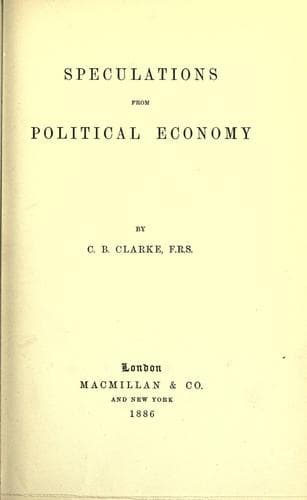
Speculations from Political EconomyClarke, Charles Baron
General
Speculations from Political Economy
Clarke, Charles Baron
Economics
is rather the contrary; for persons with large incomes are usually the
very people who already invest largely abroad, and who could (and would)
transfer their capital rapidly out of the country if they were subjected
to anything like confiscation.
Instead therefore of proceeding _upwards_ in our income tax
sliding-scale we must proceed downwards. Taking sixteen-pence in the
pound as the maximum rate we can impose on the big fish, the problem
will be, What is the highest income to which you will allow any
remission from the maximum rate? I think those having above £150 a
year possess more than the necessaries for healthful existence; looking
therefore to the equity and productiveness of the tax, I suggested
remission to those earning less than £3 a week.
9. WEALTH OF THE NATION.
The Wealth of Nations is a well-considered title. The economists
anterior to Adam Smith conceived England as surrounded by a barrier
impassable to property and money except by trade. In trade there was
an exchange apparently on equal terms; but the old economists saw a
difference in nature between imports and exports; when wool was sold
to Flanders gold was received, and remained somewhere in the nation;
it formed the national purchasing power, and could hire mercenaries or
otherwise command foreign labour and productions. Inversely, when we
imported wine or tea, we had to part with a portion of our national
purchasing power, while the wine and tea went down our throats, leaving
nothing in its place. It appeared clear that for any increase in
national wealth the value of the exports must exceed that of the
imports. Every well-prepared boy can now show in ten minutes' scribbling
in a Government examination the ridiculous folly of the old economists;
but several of them were experienced London merchants, and perhaps were
not the complete idiots they are now triumphantly shown to be. If they
had been asked whether wool was a part of the national wealth they
might have returned an answer that their modern detractors are not quite
prepared for.
Public-domain text, read in full here on John Shaqi.
Reviews
Reviews
No reviews yet
Be the first to share your thoughts on this work.
Join the Discussion
Join the discussion
Sign in to leave a comment or review.
Sign InorCreate an account