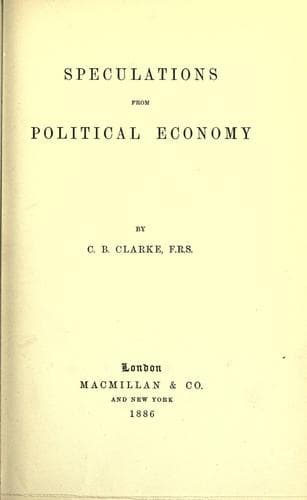
Speculations from Political EconomyClarke, Charles Baron
General
Speculations from Political Economy
Clarke, Charles Baron
Economics
To sum up: No man in ordinary business will give a price for anything
that he intends to sell again unless he expects to profit by selling
it again. No capitalist will pay a workman to make a table unless he
expects to sell the table for a sum somewhat exceeding the cost of the
wood and the workman's labour. It follows directly that the one grand
object of the workman, both as an individual, a trade, and a class,
should be to improve the efficiency of his labour. He may gain something
by combination and higgling for the turn of the market, but the limit to
what he can get is the value of his labour to his employer.
In order to attain this improved efficiency the most important
practical aid is piecework. This has done much even in agriculture: the
turnip-hoer by the acre earns more, while he does his work at his own
time with more comfort to himself than the old day-labourer. What
is more important, the men who by head and hand are superior at
turnip-hoeing are able to do the work cheaper than ordinary labourers,
and turnip-hoeing thus falls entirely to the most efficient hoers, whose
efficiency thus again gets constantly improved. There is no doubt to me
that, if the London bricklayers would arrange to work by contract, they
would soon obtain more wages without being compelled (as they imagine
would be the case) to work more severely or longer hours to gain
those wages. If they were more efficient, nothing could prevent the
competition of employers soon giving extra wages for extra value of
work.
But it may, finally, be urged that there is surely such a thing as
over-production. If there is an over-production of boots, trade is flat,
the wholesale dealers find they are making no profit, they stop their
purchases, the workmen are thrown out of employ on a large scale. To
this the reply is that there is almost a necessary alternation of up and
down in every particular trade, whether the efficiency of the workmen
is high or low. If trade is good, the large dealers will extend their
purchases, and very commonly rather over-extend their purchases: a
reaction follows, and _vice versa_ when trade is bad.
Public-domain text, read in full here on John Shaqi.
Reviews
Reviews
No reviews yet
Be the first to share your thoughts on this work.
Join the Discussion
Join the discussion
Sign in to leave a comment or review.
Sign InorCreate an account