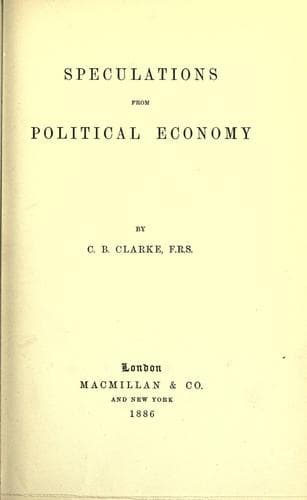
Speculations from Political EconomyClarke, Charles Baron
General
Speculations from Political Economy
Clarke, Charles Baron
Economics
But it must be recollected over-production in all trades at once is
impossible: capital is now not buried in pots by our great joint-stock
banks; if one trade is at standstill the capital is carried to the most
remunerative use that the experienced bank secretaries can discover.
If agriculture is, as we have lately seen it, in a depressed state for
years, inasmuch as wheat is "over-produced" in America till the price in
England falls to 36s. per quarter (and less), at which it hardly pays
to produce it in England; this of itself implies an enormous spur to all
other industries--the real cost of labour has in them fallen (for
the labourer will not be able to keep to himself the whole benefit of
cheapened food)--the rate of profit in all other industries has risen
(_pro tanto_). If we ever do arrive at a state when all the desires are
fully satisfied--when there is over-production in all industries--we
shall have general reduction in the hours of labour: "efficiency" will
take that form.
2. RECIPROCITY AND RETALIATION.
The wealth of England is the sum of the wealth of each individual in
England. An individual may have £10,000 in England, £5000 invested in
Australia. We may reckon his wealth in England either as including or
excluding the £5000, which he could transfer (probably very speedily) to
England in gold if he desired it tangibly. Whichever way we reckon his
wealth and that of other individuals, we shall in like manner in the
sum get the wealth of England: it will be in one case the wealth in
England-in the other case the wealth in England plus the lien which
residents in England have on other countries in the world.
In parallel manner the effective capital of England, which can be
brought into the wages fund, must be the sum of the capital of all the
individuals.
These two self-evident truths are capable of many applications: we
see directly from them that the National Debt, so far as it is held by
residents in England, neither diminishes the national wealth nor affects
the wages fund. We see also directly that any exchange between an
Englishman and a foreigner which gives a profit to the Englishman gives
an equal profit to the English nation.
Public-domain text, read in full here on John Shaqi.
Reviews
Reviews
No reviews yet
Be the first to share your thoughts on this work.
Join the Discussion
Join the discussion
Sign in to leave a comment or review.
Sign InorCreate an account