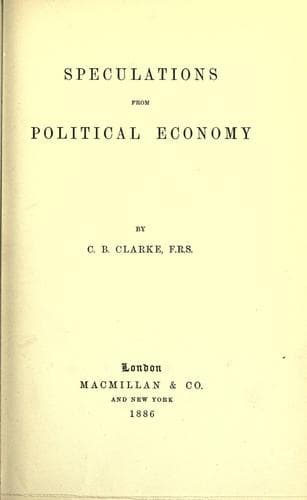
Speculations from Political EconomyClarke, Charles Baron
General
Speculations from Political Economy
Clarke, Charles Baron
Economics
When a merchant buys 1000 quarters of wheat from America and pays in
gold, he does so to make a profit for himself; but he cannot make a
profit for himself without making an equal profit for the nation. The
exchange of the wheat for gold is profitable to both seller and buyer;
otherwise the bargain would not be struck. A value is added to the wheat
by its being brought from Minnesota (where it is wanted, as all good
things are wanted) to London, where it is much more wanted, and this
increased value is greater than the cost of moving the wheat from
Minnesota to London; this excess is the profit on the exchange which
the buyer and seller divide between them. The exact shares in which they
divide the profit between them depend on some of the most complicated
considerations in the science of political economy. Indeed, political
economy can no more work out a case in figures, even when every
circumstance is given, than political economy can tell in pounds
sterling what should be the rent of a given farm. But the point required
for our present purpose is easy and certain,--unless the English buyer
got _some_ share in the profit he would not give his gold for the wheat.
The great principle of Free Trade is that in this, and in all similar
cases, the individual shall be left to make what profit he can; that his
dealings with foreigners shall be interfered with by Government in no
way; that he shall not be checked in his operations by import duties,
bounties on exports, staples, or any other of the numerous obsolete
interferences in the statute-book. The principle is that each individual
can manage his own trade better than Government can manage it for him;
that, therefore, Government shall let any individual do his best in
trade his own way, knowing that whatever profit an individual makes in
foreign trade is an equal national profit.
It may be shortly stated that in the old Protectionist theory, destroyed
by Adam Smith, gold was considered to be wealth. Hence, if an individual
bought foreign wheat for gold, the English suffered a national loss of
wealth, and the foreign nation made a national gain. It is unnecessary
to occupy space in refuting this (to us absurd) idea, as no refutation
can be more satisfactory than Adam Smith's own.
If I profit on the transaction of buying 1000 quarters of wheat for
gold, I do so irrespectively of all other exchanges by others. Whether
the firm next door to me has succeeded in selling to a Boston house
£2000 worth of Sheffield cutlery or no is a matter entirely beside
my bargain. My profit will depend practically on the movements in the
English corn trade: a small rise in the price of wheat at Mark Lane
between the date of my purchasing by cable the wheat in America and my
selling it at Mark Lane, may give me a large profit, or _vice versa_.
But my exchange of gold for the wheat is a separate transaction of
itself: it stands entirely on its own bottom.
Public-domain text, read in full here on John Shaqi.
Reviews
Reviews
No reviews yet
Be the first to share your thoughts on this work.
Join the Discussion
Join the discussion
Sign in to leave a comment or review.
Sign InorCreate an account