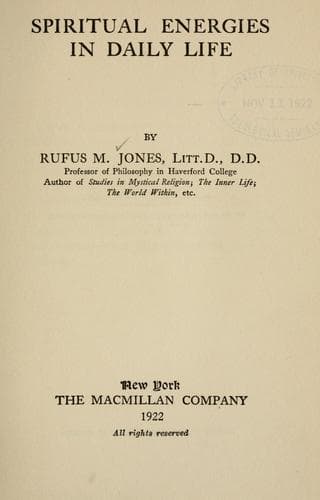
Spiritual Energies in Daily LifeJones, Rufus M. (Rufus Matthew)
Religion
Spiritual Energies in Daily Life
Jones, Rufus M. (Rufus Matthew)
Spiritual life
This _way_ is no less urgent for the solution of the most acute
international situations. It has been assumed too long and too often that
these situations can be best handled by unlimited methods of restraint,
coercion, and reduction to helplessness. Some of the countries of Europe
have been plainly suffering from neurasthenia, dissociation, and the
kindred forms of emotional, fear-caused diseases. Starvation always makes
for types of hysteria. It will not do now to apply, with cold, precise
logic, the old vindictive principle that when the sinner has been made
to suffer enough to “cover” the enormity of his sin he can then be
restored to respectable society. It is not vindication of justice which
most concerns the world now; it is a return of health, a restoration of
normal functions, a reconstruction of the social body. That task calls
for the application of the deeper, truer principles of life. It calls for
a knowing heart, an understanding method, a healing plan, a sympathetic
guide who can obliterate the fear-attitude and _suggest_ confidence and
unity and trustful human relationships. Those great words, used in the
Epistle of London Yearly Meeting of Friends in 1917, need to be revived
and put to an experimental venture: “_Love knows no frontiers._” There is
no limit to its healing force, there are no conditions it does not meet,
there is no terminus to its constructive operations.
II
HE CAME TO HIMSELF
Was there ever such a short-story character sketch as this one of the
prodigal son! No realism of details, no elaboration of his sins, and
yet the immortal picture is burned forever into our imagination. The
_débâcle_ of his life is as clear and vivid as words can portray the
ruin. Yet the phrase which arrests us most as we read the compact
narrative of his undoing is not the one which tells about “riotous
living,” or the reckless squandering of his patrimony, or his hunger for
swine husks, or his unshod feet and the loss of his tunic; it is rather
the one which says that when he was at the bottom of his fortune “he came
to himself.”
He had not been himself then, before. He was not finding himself in the
life of riotous indulgence. That did not turn out after all to be the
life for which he was meant. He missed himself more than he missed his
lost shoes and tunic. That raises a nice question which is worth an
answer: When is a person his real self? When can he properly say, “At
last I have found myself; I am what I want to be?” Robert Louis Stevenson
has given us in Dr. Jekyll and Mr. Hyde a fine parable of the actual
double self in us all, a higher and a lower self under our one hat. But
I ask, which is the real me? Is it Jekyll or is it Hyde? Is it the best
that we can be or is it this worse thing which we just now are?
Most answers to the question would be, I think, that the real self is
that ideal self of which in moments of rare visibility we sometimes
catch glimpses.
Public-domain text, read in full here on John Shaqi.
Reviews
Reviews
No reviews yet
Be the first to share your thoughts on this work.
Join the Discussion
Join the discussion
Sign in to leave a comment or review.
Sign InorCreate an account