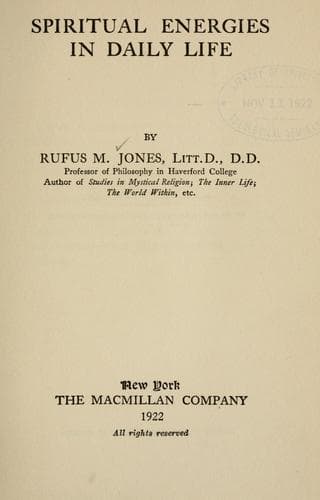
Spiritual Energies in Daily LifeJones, Rufus M. (Rufus Matthew)
Religion
Spiritual Energies in Daily Life
Jones, Rufus M. (Rufus Matthew)
Spiritual life
“All I could never be,
All, men ignored in me,
This, I was worth to God, whose wheel the pitcher shaped.”
“Dig deep enough into any man,” St. Augustine said, “and you will find
something divine.” We supposed he believed in total depravity, and
he does in theory believe in it; but when it is a matter of actual
experience, he announces this deep fact which fits perfectly with his
other great utterance: “Thou, O God, hast made us for thyself, and we are
restless (dissatisfied) until we find ourselves in thee.”
Too long we have assumed that Adam, the failure, is the type of our
lives, that he is the normal man, that to err is human, and that one
touch, that is, blight, of nature makes all men kin. What Christ has
revealed to us is the fact that we always have higher and diviner
possibilities in us. He, the overcomer, and not Adam, is the true type,
the normal person, giving us at last the pattern of life which is life
indeed.
Which is the real self, then? Surely this higher possible self, this one
which we discover in our best moments. The Greeks always held that sin
was “missing the mark”—that is what the Greek word for sin means—failure
to arrive at, to reach, the real end toward which life aims. Sin is
defeat. It is loss of the trail. It is undoing. The sinner has not found
himself, he has not come to himself. He has missed the real me. He cannot
say, “I am.”
If that is a fact, and if the life of spiritual health and attainment is
the normal life, we surely ought to do more than is done to help young
people to realize it and to assist them to find themselves. We are much
more concerned to manufacture things than we are to make persons. We do
one very well and we do the other very badly. Kipling’s “The Ship that
Found Itself” is a fine account of the care bestowed upon every rivet and
screw, every valve and piston. He pictures the ship in the stress and
strain of a great storm and each part of the ship from keel to funnel
describes what it has to bear and to do in the emergency and how it has
been prepared in advance for just this crisis. Nansen was asked how he
felt when he found that the _Fram_ was caught in the awful jam of the
Arctic ice-floe. “I felt perfectly calm,” he said. “I knew she could
stand it. I had watched every stick of timber and every piece of steel
that went into her hull. The result was that I could go to sleep and
let the ice do its worst.” With even more care we build the airplane.
There must be no chance for capricious action. The propeller blades must
be made of perfect wood. There must be no defect in any piece of the
structure. The gasoline must be tested by all the methods of refinement.
The oil must be absolutely pure, free of every suspicion of grit.
Public-domain text, read in full here on John Shaqi.
Reviews
Reviews
No reviews yet
Be the first to share your thoughts on this work.
Join the Discussion
Join the discussion
Sign in to leave a comment or review.
Sign InorCreate an account