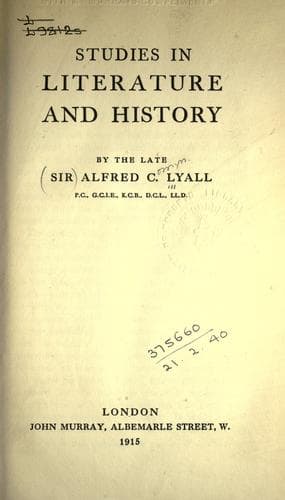
Studies in Literature and HistoryLyall, Alfred C., Sir
Religion
Studies in Literature and History
Lyall, Alfred C., Sir
English literature; History; Literature; Religion; Utilitarianism
We can understand without difficulty why the eighteenth century was a
period favourable to the growth of excellent letter-writing. There
were very few newspapers, and those which appeared were low in tone
and ill-informed--political pamphleteers abounded and the essayists on
morals and manners were numerous--but it was chiefly by private hands
that accurate information and ideas were circulated in a small and
highly cultivated society with an exquisite taste in literature, with
a keen interest in public affairs, and a very strong appetite for
philosophic discussion. Side by side with the intellectual conditions
we may take into account the national circumstances of that age. The
post was expensive, with a slow and intermittent circulation, so that
letters, being infrequent, were worth writing carefully and at
length; while correspondents were nevertheless not separated by
distances of time and space sufficient to weaken or extinguish the
desire of interchanging thoughts and news. For it is within the
experience of most of us that the difficulty of keeping up regular
correspondence increases with distance; that friends who meet seldom
write to each other rarely; and that, although letters are most valued
by those who are far from home and long absent, yet it is precisely in
the case of prolonged separation that the chain of friendly
communication is apt gradually to slacken until it becomes entirely
disconnected. So long, indeed, as men depended for news on private
sources, there was always a kind of obligation to write; but the
telegraph and the newspaper have now monopolised the Intelligence
Department. On the whole, it may be concluded that the art of
letter-writing flourishes best within a limited radius of distance,
among persons living neither very near to each other nor yet far
apart, who meet occasionally yet not often, and who are within the
same range of social, political, and intellectual influences. Its best
period is probably before the advent of copious indefatigable
journalism, before men have taken to publishing letters in the morning
papers, and when they have not yet acquired the economical habit of
reserving all their valuable ideas and information for signed articles
in some monthly review.
Public-domain text, read in full here on John Shaqi.
Reviews
Reviews
No reviews yet
Be the first to share your thoughts on this work.
Join the Discussion
Join the discussion
Sign in to leave a comment or review.
Sign InorCreate an account