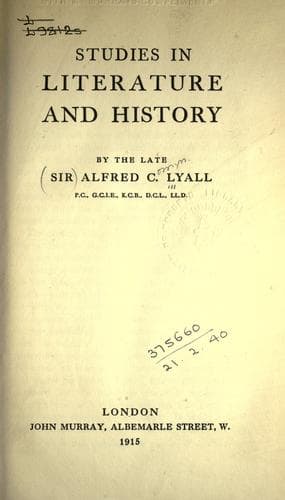
Studies in Literature and HistoryLyall, Alfred C., Sir
Religion
Studies in Literature and History
Lyall, Alfred C., Sir
English literature; History; Literature; Religion; Utilitarianism
It was under these conditions that the letters of eminent men in the
eighteenth century and the early part of the nineteenth century were
generally written. In the former century letter-writing was
undoubtedly a recognised form of high literary workmanship, with close
affinities on one side to the diary or private journal, and on another
to the essay. Long, continuous, and intimate correspondence, as in the
case of Swift and Walpole, gravitated toward the journal;
dissertations on literature, politics, and manners were more akin to
the essay; while in the hands of the novelist the journalistic series
of letters took artificial development into a method of story-telling.
On the other side, the tendency of epistles to become essays reached
its climax in the letters of Burke, some of which are only
distinguishable from brilliant pamphlets by the formal address and
subscription.
With the nineteenth century begins an era of amusing and animated
letter-writing. The classic and somewhat elaborate style of the
preceding age falls into disuse; the essayist draws gradually back
into a department of his own; the new school reflects, as is natural,
the general tendency of English literature toward a livelier and more
varied movement, with a wider range of subjects and sympathies. In his
letters, as in his poetry, the precursor of the Naturalistic school
was Cowper, who could be simple without being trivial, was never prosy
and often pathetic, and who possessed the rare art of stamping on his
reader's mind an enduring impression of quiet and somewhat commonplace
society in the English midlands. That poets should usually have been
good letter-writers is probably no more than might have been expected,
for imagination and word-power must tell everywhere; yet the list is
so long as to be worth noticing. Swift, Pope, Gray, and Cowper in the
last century, and in the present century Scott, Byron, Shelley,
Coleridge, and Southey, have all left us distinctive and copious
correspondence. Wordsworth may, perhaps, be classed as a notable
exception; for Wordsworth's letters are dull, being at their best more
like essays or literary dissertations than the free outpouring of
intimate thought. They have none of the charm which comes from the
revelation of private doubt or passionate affection that is
ordinarily stifled by convention; they are, on the contrary, eminently
respectable, deliberate, and carefully expressed. 'It has ever been
the habit of my mind,' he writes, 'to trust that expediency will come
out of fidelity to principles, rather than to seek my principles of
action in calculations of expediency.' This is what the Americans call
'high toned'; but the metal is too heavy for the light calibre of a
letter.
Public-domain text, read in full here on John Shaqi.
Reviews
Reviews
No reviews yet
Be the first to share your thoughts on this work.
Join the Discussion
Join the discussion
Sign in to leave a comment or review.
Sign InorCreate an account