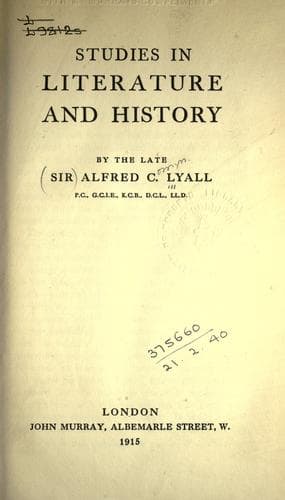
Studies in Literature and HistoryLyall, Alfred C., Sir
Religion
Studies in Literature and History
Lyall, Alfred C., Sir
English literature; History; Literature; Religion; Utilitarianism
Whether Tennyson had the gift of letter-writing we shall be able to
judge when his biography appears; though we may anticipate that it
will contain some things worthy of a great master in the art of
language. The publication of letters deriving their sole or principal
interest from the general reputation of the writer is indeed quite
legitimate and intelligible. They are often biographical documents of
considerable value, apart from all questions of style and intellectual
quality; they can be handled and arranged to exhibit a man's
character; they may be used as negative proofs of reserve and
reticence, as showing his mental attitude toward various subjects, his
domestic habits and virtues, or merely as annals of where he went and
what he did. They may be carefully selected and revised for occasional
insertion at different stages of a long biography, where the editor
sees fit to let the dead man speak for himself; they may be employed
as an advocate chooses the papers in his brief, for attack or defence.
Or they may be produced without commentary, sifting, or omissions, as
the unvarnished presentation of a man's private life and particular
features which a candid friend commits to the judgment of posterity.
Or, lastly, they may be mere relics, not much more in some instances
than curiosities, valued for much the same reasons that would set a
high price on the autograph or the inkstand of a celebrated man, on
his furniture, his house, or anything that was his. In proportion as
little or nothing is known of such a man's private life, every scrap
of his writing increases in value; and so a letter of Shakespeare or
of Dante would be priceless. But of Shakespeare no letter has come
down to us; and of Dante not even, we believe, his signature; though
we do know something of what Dante did and thought, for his religion
and his politics are manifested in his poems; whereas Shakespeare's
works have the divine attribute of impersonality. Here is one supreme
poet of whom the world would gladly hear anything; but nothing remains
to feed the modern appetite, which is never so well gratified as when
a rare and sublime genius stands revealed as the writer of ordinary
letters upon petty domesticities.
Public-domain text, read in full here on John Shaqi.
Reviews
Reviews
No reviews yet
Be the first to share your thoughts on this work.
Join the Discussion
Join the discussion
Sign in to leave a comment or review.
Sign InorCreate an account