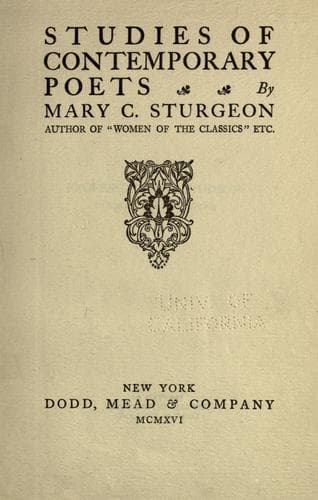
English poetry -- 20th century -- History and criticism
Life, the mother who lets her children play
So seriously busy, trade and craft,--
Life with her skill of a million years' perfection
To make her heart's delighted glorying
Of sunlight, and of clouds about the moon,
Spring lighting her daffodils, and corn
Ripening gold to ruddy, and giant seas,
And mountains sitting in their purple clothes--
O life I am thinking of, life the wonder,
All blotcht out by a brutal thrust of fire
Like a midge that a clumsy thumb squashes and smears.
That passage will serve to point the single comment on technique with
which this study must close. It has not been selected for the purpose,
and therefore is not the finest example that could be chosen. It is,
however, typical of the blank-verse form which largely prevails in this
poetry, and which, in its very texture, reveals the same extraordinary
combination of qualities which we have observed in the poet's genius.
We have already seen that spiritual vision is here united with
intellectuality as lucid as it is powerful: that the mystic is also the
humanitarian: that imagination is balanced by a good grip on reality;
and that the sense-impressions are fine as well as exuberant. We have
seen, too, that this diversity and apparent contrast, although resulting
in an art of complex beauty, do not tend towards confusion or obscurity.
There has been a complete fusion of the elements, and the molten stream
that is poured for us is of glowing clarity.
Exactly the same feature is discernible in the style of this verse. Look
at the last passage for a moment and consider its effect. It is
impossible to define in a single word, because of its complexity. The
mind, lingering delightedly over the metaphor of life the mother, is
suddenly awed by the magnitude of the idea which succeeds it. The
æsthetic sense is taken by the light and colour of the middle lines, and
then, as if the breath were caught on a half-sob, a wave of emotion
follows, pensive at first, but rising abruptly to a note that is as
rough as a curse. There are more shades of thought, lightly reflective
or glooming with prescience; and there are more degrees of emotion, from
tenderness to wrath, than we have time to analyze. The point for the
moment is the manner in which they are conveyed, and the adequacy of the
instrument to convey them.
The texture of the verse itself will provide evidence of this. Here are
barely a dozen lines of our English heroic verse; and they will be found
to contain the maximum of metrical variety. Probably only two, or at
most three of them (it depends upon scansion, of course) are of the
regular iambic pentameter: that is to say, built up strictly from the
iamb, which is the unit of this form. All the others are varied by the
insertion at some point in the line, and frequently at two or three
points, of a different verse-unit, dactyl, anapæst, trochee or spondee;
and no two lines are varied in exactly the same way.
Public-domain text, read in full here on John Shaqi.
Reviews
Reviews
No reviews yet
Be the first to share your thoughts on this work.
Join the Discussion
Join the discussion
Sign in to leave a comment or review.
Sign InorCreate an account