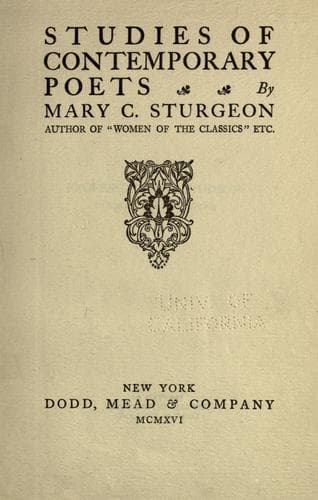
English poetry -- 20th century -- History and criticism
He slips back again into the softer mood of memory, not of the immediate
home scenes only, but of their associations, historical and academic.
Always, however, that keen helmsman steers to the windward of
sentimentality: better risk rough weather, it seems to say, than
shipwreck on some lotus-island. And every time the boat would appear to
be making fairly for an exquisite idyllic haven, she is headed into the
breeze again. But though she gets a buffeting, and even threatens to
capsize at one moment in boisterous jest, she comes serenely into port
at last.
Say, do the elm-clumps greatly stand
Still guardians of that holy land?
The chestnuts shade, in reverend dream,
The yet unacademic stream?
Is dawn a secret shy and cold
Anadyomene, silver-gold?
And sunset still a golden sea
From Haslingfield to Madingley?
And after, ere the night is born,
Do hares come out about the corn?
Oh, is the water sweet and cool,
Gentle and brown, above the pool?
And laughs the immortal river still
Under the mill, under the mill?
Say, is there Beauty yet to find?
And Certainty? and Quiet kind?
Deep meadows yet, for to forget
The lies, and truths, and pain?... oh! yet
Stands the Church clock at ten to three?
And is there honey still for tea?
_William H. Davies_
I should think that the work of Mr Davies is the nearest approach that
the poetic genius could make to absolute simplicity. It is a wonderful
thing, too, in its independence, its almost complete isolation from
literary tradition and influence. People talk of Herrick in connexion
with this poet; and if they mean no more than to wonder at a resemblance
which is a marvellous accident, one would run to join them in their
happy amazement. But there is no evidence of direct influence, any more
than by another token we could associate his realism with that of
Crabbe. No, this is verse which has "growed," autochthonic if poetry
ever were, unliterary, and spontaneous in the many senses of that word.
From that one fact alone, these seven small volumes of verse are a
singular phenomenon. But they teem with interest of other kinds too.
First and foremost there is, of course, the preciousness of many of the
pieces they contain, as pure poetry, undimmed by any other consideration
whatsoever. That applies to a fair proportion of this work; and it is a
delightsomeness which, from its very independence of time and
circumstance, one looks quite soberly to last the centuries through; and
if it lapse at all from favour, to be rediscovered two or three hundred
years hence as we have rediscovered the poets of the seventeenth
century.
Public-domain text, read in full here on John Shaqi.
Reviews
Reviews
No reviews yet
Be the first to share your thoughts on this work.
Join the Discussion
Join the discussion
Sign in to leave a comment or review.
Sign InorCreate an account