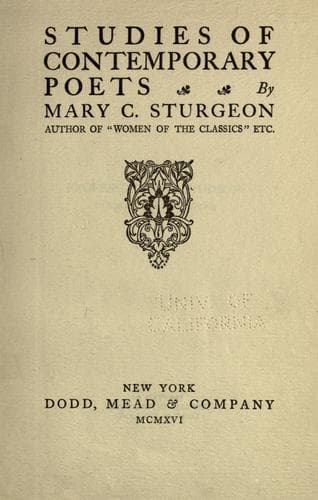
English poetry -- 20th century -- History and criticism
It has, however, inherent interest apart from this æsthetic joy,
something which catches and holds the mind, startling it with an
apparent paradox. For this poetry, with its solitariness and absence of
any affiliation ancient or modern, with its bird-note bubbling into song
at some sweet impulse and seemingly careless of everything but the
impelling rapture, is at the same time one of the grimmest pages out of
contemporary life. In saying that, one pauses for a moment sternly to
interrogate one's own impression. How much of this apparent paradox is
due to knowledge derived from the author's astounding autobiography?
Turn painfully back for a moment to the thoughts and feelings aroused by
that book: recall the rage against the stupidity of life which brings
genius to birth so carelessly, endowing it with appetites too strong for
the will to tame and senses too acute for the mind to leash until the
soul had been buffeted and the body maimed. And admit at once that such
a tale, all the more for its quiet veracity, could not fail to influence
one's attitude to this poetry. No doubt it is that which gives
assurance, certainty, the proof of actual data, to the human record
adumbrated in the poems. But the record is no less present _in_ the
poems. It often exists, implicit or explicit, in that part of the verse
which sings because it must and for sheer love of itself. And in that
other part of the work where the lyric note is not so clear: in the
narrative poems and queer character-studies and little dramatic pieces,
the record lives vivid and almost complete. Perhaps it is the nature of
the record itself which denies full inspiration to those pieces: perhaps
Mr Davies' lyric gift cannot find its most fitting expression in themes
so grim: in any case it is clear that these personal pieces are not
equal to the lighter songs.
Now if one's conscience were supple enough to accept those lighter songs
as Mr Davies' complete work: if we could conveniently forget the
autobiography, and when visualizing his output, call up some charming
collected edition of the poems with the unsatisfactory ones carefully
deleted, we could go on with our study easily and gaily. We might pause
a moment to marvel at this 'isolated phenomenon': we might even remark
upon his detachment, not only from literature, but almost as completely
from the ordinary concerns of life. That done, however, we should at
once take a header into the delicious refreshment of the lyrics. Such a
study would be very fascinating; and from the standpoint of Art as Art,
it might not be inadequate. But it would totally lack significance. Even
from the point of view of pure poetry, the loss would be profound--not
to realize that behind the blithest of these trills of song is a
background as stormy as any winter sky behind a robin on a bare bough.
There is this one, for example, from the volume called _Foliage_:
Public-domain text, read in full here on John Shaqi.
Reviews
Reviews
No reviews yet
Be the first to share your thoughts on this work.
Join the Discussion
Join the discussion
Sign in to leave a comment or review.
Sign InorCreate an account