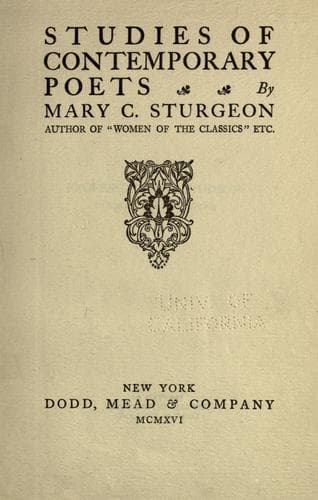
English poetry -- 20th century -- History and criticism
Well, the heap's down yonder--
There, at the turning.
Ah, the bonnie babe!
We had no children, mistress.
And what can any old man do with shillings,
With no one but himself to spend them on--
An idle, good-for-nothing, lone old man?
The curious structure of the verse is apparent at a glance--the
irregular pattern, the extreme variation in the length of the line, the
absence of rhyme and the strange metrical effects. It is a new poetical
instrument, having little outward resemblance to the grace and dignity
of regular forms. Its unfamiliarity may displease the eye and the ear at
first, but it is not long before we perceive the design which controls
its apparent waywardness, and recognize its fitness to express the life
that the poet has chosen to depict. For it suggests, as no rhyme or
regular measure could, the ruggedness of this existence and the
characteristic utterance of its people. No symmetrical verse, with its
sense of something complete, precise and clear, could convey such an
impression as this--of speech struggling against natural reticence to
express the turmoil of thought and emotion in an untrained mind. Mr
Gibson has invented a metrical form which admirably produces that
effect, without condescending to a crude realism. He has made the worker
articulate, supplying just the coherence and lucidity which art demands,
but preserving, in this irregular outline, in the plain diction and
simple phrasing, an acute sense of reality. Here is a fragment of
conversation, one of many similar, in which this verse is found to be a
perfect medium of the idea. A wife has been struck by her husband in a
fit of passion: she has been trying to hide from her mother the cause of
the blow, but she is still weak from the effects of it and has not lied
skilfully. Her mother gently protests that she is trying to screen her
husband:
Nay! There's naught to screen.
'Twas I that ... Nay!
And, if he's hot, at times,
You know he's much to try him;
The racket that he works in, all day long,
Would wear the best of tempers.
Why, mother, who should know as well as you
How soon a riveter is done?
The hammers break a man, before his time;
And father was a shattered man at forty;
And Philip's thirty-five;
And if he's failed a bit ...
And, sometimes, over-hasty,
Well, I am hasty, too;
You know my temper; no one knows it better.
Public-domain text, read in full here on John Shaqi.
Reviews
Reviews
No reviews yet
Be the first to share your thoughts on this work.
Join the Discussion
Join the discussion
Sign in to leave a comment or review.
Sign InorCreate an account