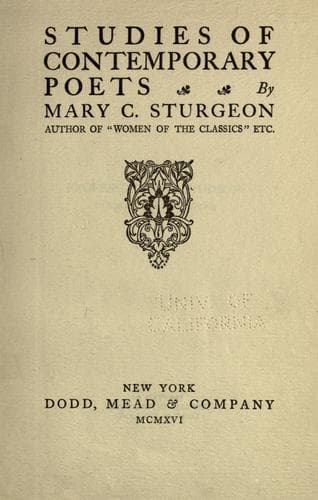
English poetry -- 20th century -- History and criticism
Occasionally, it is true, the principle on which the verse is built is
too strictly applied: the phraseology is abrupt beyond the required
effect; and the lines, instead of following a rule which seems to
measure their length by a natural pause, are broken arbitrarily.
Speaking broadly, however, it is beautifully fitted to the themes of
_Daily Bread_, though one is not so sure about it in a poem like "Akra
the Slave." This is a delightful narrative, akin in subject to the
earlier work, and belonging to that period much more than to the date at
which it was published, 1910. One cannot linger upon it, nor even upon
the more important work which followed, and is happily still
continuing--more important because it indicates development and marked
progress along the new lines. The three parts of _Fires_ carry forward
the conception of _Daily Bread_, but now in narrative style, permitting
therefore a relaxation of the austere dramatic truth of the dialogue
form. The verse is modified accordingly, as will be seen in this passage
from "The Shop": A workman has entered his favourite shop--the little
general-store of a poor neighbourhood--to buy his evening paper. But he
is not attended to immediately; and a sickly little girl who has come
for a fraction of a loaf and a screw of tea, is also waiting. The
shopkeeper is engrossed with a parcel from the country--from a little
convalescent son who has gone for the first time to his father's native
place:
Next night, as I went in, I caught
A strange, fresh smell. The postman had just brought
A precious box from Cornwall, and the shop
Was lit with primroses, that lay atop
A Cornish pasty, and a pot of cream:
And as, with gentle hands, the father lifted
The flowers his little son had plucked for him,
He stood a moment in a far-off dream,
As though in glad remembrances he drifted
On Western seas: and, as his eyes grew dim,
He stooped, and buried them in deep, sweet bloom:
Till, hearing, once again, the poor child's cough,
He served her hurriedly, and sent her off,
Quite happily, with thin hands filled with flowers.
And, as I followed to the street, the gloom
Was starred with primroses; and many hours
The strange, shy flickering surprise
Of that child's keen, enchanted eyes
Lit up my heart, and brightened my dull room.
Public-domain text, read in full here on John Shaqi.
Reviews
Reviews
No reviews yet
Be the first to share your thoughts on this work.
Join the Discussion
Join the discussion
Sign in to leave a comment or review.
Sign InorCreate an account