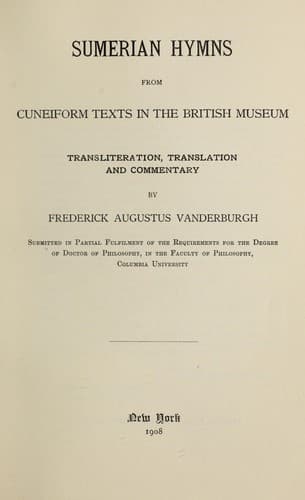
Sumerian Hymns from Cuneiform Texts in the British Museum
Religion
Sumerian Hymns from Cuneiform Texts in the British Museum
Hymns, Sumerian; Sumerian language -- Texts
Ramman’s most esteemed service was that of bestowing blessing. The rains
in the right proportion were a boon to the land, filling the canals and
watering the soil. Ḥammurabi calls Ramman the lord of abundance and his
helper. Tiglath-pileser I. prays for the blessings of prosperity, as he
prays to Adad: “May Anu and Adad turn to me truly and accept graciously
the lifting up of my hand, hearken unto my devout prayers, grant me and
my reign abundance of rain, years of prosperity and fruitfulness in
plenty.”[26] Ašurbânipal describes the blessings he receives by the
favor of this god: “Ramman let loose his showers and Ea has opened his
springs, the grain has grown to a height of five yards and the ears have
been five sixths of a yard long, the produce of the land has been
abundant and the fruit trees have borne fruit richly.”[27] The mention
of Anu and Ea with Ramman is because of their power to produce water, Ea
representing the depths of water and Anu the heaven with its clouds of
rain.
The most conspicuous work of Ramman was that of destruction. It is in
this function of judgment that he is associated with Šamaš. The
connection lies in the fact that the lightning of Ramman is like the
day-light of Šamaš; so, as the god of lightning, Ramman has the title
_birḳu_. Lightning and flooding rain were, because of their destructive
character, fearful forces, and the kings in calling for a curse on
hostile man or land turn to Ramman in imprecation, as, for example,
Raman-Nirari I. does concerning the man who may be tempted to blot out
the record of Ramman-Nirari’s name: “May Ramman with terrible rainstorm
overwhelm him, may flood, destruction, wind, rebellion, revolution,
tempest, want and famine, drought and hunger be continually in his land.
May he come down on his land like a flood. May he turn it into mounds
and ruins. May Ramman strike his land with a destructive bolt.”[28]
Some Babylonian composer has set forth the terrifying side of Ramman’s
character in a bilingual hymn as follows:
“The lord in his anger himself makes heaven quake.
Adad in his wrath lifts up the earth.
The mighty mountain he himself smites down.
At his anger, at his wrath,
At his roaring, at his thundering,
The gods of heaven ascend to heaven,
The gods of earth enter earth,
Šamaš into the foundation of heaven enters,
Sin in the height of heaven is magnified.”[29]
4. _Tammuz_
There is a fascination about the life of Tammuz not experienced in the
contemplation of the other gods of Babylonia. He seems to be presented
to us just as though he were a man.
Public-domain text, read in full here on John Shaqi.
Reviews
Reviews
No reviews yet
Be the first to share your thoughts on this work.
Join the Discussion
Join the discussion
Sign in to leave a comment or review.
Sign InorCreate an account