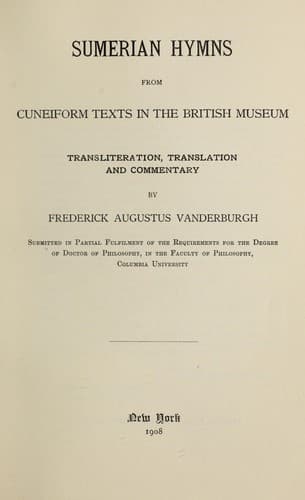
Sumerian Hymns from Cuneiform Texts in the British Museum
Religion
Sumerian Hymns from Cuneiform Texts in the British Museum
Hymns, Sumerian; Sumerian language -- Texts
_laḥ-na_: _zal laḥ-na_ means “his shining oil”, and the thought appears
to be that Bêl causes food to be produced to sustain successive
generations. His oil is milk for many generations. _zal-laḥ_ is somewhat
like the expression “finest oil” found in Assyrian inscriptions.
_laḥ_: the signs ḤISSU and ṢÂBU find their nearest approach to each
other in the value _laḥ_. Both signs have this value with the meaning
“brightness”.
_na_ here is a suffix of the third person; sometimes it is second person
(see line 1).
_ga_: our sign here is the old Babylonian GÛ which with its common value
_ga_ means _šizbu_, “milk”. The archaic linear form represents the teat
of the breast. _ga_ occurs often as a phonetic complement (see line 4).
_nunuz-ám_ means “is multitudinous”. _nunuz_: NUNUZ in this form is, as
Delitzsch observes (HW. p. 525b), New-Babylonian. In Assyrian it is
composed of ṢAB and ḤI and in New-Babylonian of ṢAB and ŠE. Here it is
equal to the Assyrian _lîpu_, German “Nachkomme”.
_ám_: A.AN, equalling _ám_, is a well recognized verbal suffix used like
the verb “to be”; for instance, _dingir-ra ám_ means “is a god” and
_gal-la ám_ means “is great” (see SVA. p. 56).
_da-ma-al-la_ is composed of the adjective _da-ma-al_ and the phonetic
complement _la_. _da-ma-al_ is the phonetic representation in ES of the
sign AMÛ meaning _rapšu_ (see line 10).
13. _ù-mu-un silim-ma-a-ni eri ir-ir_
The lord whose decrees bind together the city.
_silim-ma-a-ni_ means “his decree”. Thus, _silim-ma-a_ equals noun, plus
phonetic complement, plus vowel prolongation. _silim_: we have had the
sign SARARÛ (in line 7), where it was given the value _di_; here,
however, the phonetic complement suggests the choice of the value
_silim_, from which we derive the meaning “decree”, although
“salutation” is a more primary meaning expressed by the Semitic value
_silim_ (from _šulmu_). The sign is apparently New-Babylonian.
_ni_ is one of the common nominal suffixes of the third person. Note
that Bêl is addressed in the third person in this line, but we shall
find him addressed in the second person again in line 16.
_eri_ is ES for the EK _uru_. This value is substantiated by the name of
the city of Eridu = _Eri-ṭu_, (see MSL. p. 105). The name of the sign is
_ALU_. Our sign is old Babylonian and is not very different from the
hieroglyphic form which is supposed to represent a city (see AL. p. 121,
No. 21). It differs considerably from the New-Babylonian ALU which is
much like the Assyrian.
_ir-ir_ is an intensive form of the verb and therefore may be causative.
Bêl is supposed to have aided kings especially in capturing cities. _ir_
may mean “bind”, expressed by _kamû_, but _kamû_ is not so often
represented by IR as by DIBBU or LALLU. _kamû_ may be represented by PA
(see line 9). Although _ir_ is said to be a Semitic value, it is used in
this hymn syllabically and is the only value of the sign preserved (see
line 1 and also _dù_ in line 11 for further comment).
Public-domain text, read in full here on John Shaqi.
Reviews
Reviews
No reviews yet
Be the first to share your thoughts on this work.
Join the Discussion
Join the discussion
Sign in to leave a comment or review.
Sign InorCreate an account