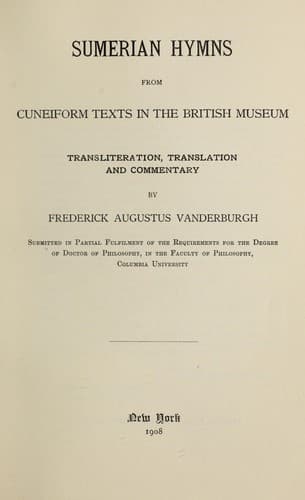
Sumerian Hymns from Cuneiform Texts in the British Museum — John Shaqi
Sumerian Hymns from Cuneiform Texts in the British Museum
Religion
Sumerian Hymns from Cuneiform Texts in the British Museum
Hymns, Sumerian; Sumerian language -- Texts
_ta_ is a postposition meaning in this case “from”, but often “in,
into”. TA in our text is old Babylonian and much like the linear form in
early tablets. Nearly the same form can be found in Ḥammurabi also. But
on the whole, the old Babylonian, the Assyrian and the New-Babylonian
all differ from each other much. TA has a close relation to DA and ID
(see on line 14).
_^dimmer Babbar-šu-šù_ equals ideogram for “the sun”, plus _šu_ = “going
in”, plus postposition “to”.
_šu_ equals _erêbu_, “enter in”. Ideographically, ŠU means “bent over”,
or “depressed”.
_šù_ is a value of KU, as a postposition, meaning “unto”. The sign is of
rectangular form and has many values, consequently many meanings
starting with the idea “enclosure”. The governing force of _šù_ here
reaches back over _kur_ in the middle of the line, just as the governing
force of _ta_ goes back over _kur_ at the beginning of the line.
The beautiful expression of this line occurs more than once in Sumerian
and Babylonian literature. As early as Lugalziggisi it appears in royal
writings. Lugalziggisi speaks of his kingdom as extending “from the
rising sun to the setting sun”. _Babbar-ê-ta_ (UD.UD.DU.TA)
_Babbar-šu-šù_ (UD.ŠU.KU) (OBI. No. 87, Col. II, 12 and 13). And
Esarhaddon in Cylinder A says that “From the rising sun to the setting
sun he marched without a rival”. _ul-tu ⋅i-it ^ilu Šam-ši a-di e-rib
^ilu Šam-ši it-tal-lak-u-ma ma-ḥi-ra la i-šu-u_ (I R. 45, Col. I, 7 and
8).
16. _kur-ra ù-mu-un nu-um-ti za-e ù-mu-un ab-da-me-en_
O mountain, the lord of life, thou the lord indeed art!
_kur-ra_ (see on line 3).
_ù-mu-un_ (see on line 1).
_nu-um-ti_ occurs also in the next line and no doubt equals _balâṭu_,
“life”.
_nu-um_ seems to be an abstracting prefix of the nature of _nam_ as in
_nam-ti-la_ = _balâṭu_ (Br. 1697). _nu-um-ti_, however, may be a
phonetic representation of _nim_, also written _num_ which means
_elîtu_, “height” (Br. 1982 and 9011). According to this view,
_nu-um-ti_ might mean “the acme of life”, just as _nam-ti_ equals “the
fortune of life”; hence “life in general”. Or it might be suggested that
_num_ is really for _nam_, as _a_ is known to differentiate sometimes
into _u_; _ga_ for instance becomes _gu_ (MSL. p. X).
_ti_ equals _balâṭu_, “life”, and has its fuller form in _tin_, also
equal to _balâṭu_ “live”.
_za-e_ equals _atta_, “thou” (Br. 11762, also ASK. p. 139).
Public-domain text, read in full here on John Shaqi.
Reviews
Reviews
No reviews yet
Be the first to share your thoughts on this work.
Join the Discussion
Join the discussion
Sign in to leave a comment or review.
Sign InorCreate an account