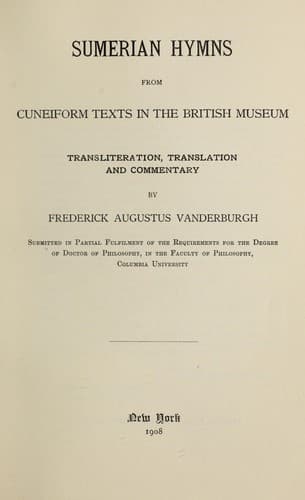
Sumerian Hymns from Cuneiform Texts in the British Museum
Religion
Sumerian Hymns from Cuneiform Texts in the British Museum
Hymns, Sumerian; Sumerian language -- Texts
_an-na_: _an_ equaling _šamê_, “heavens”, is a value of ANÛ attested by
the phonetic complement _na_. The sign ANÛ in our text is old Babylonian
and is the same as the original ideogram of the star, except that wedges
have taken the place of straight lines. In our Hymn to Adad (CT. XV,
Tablet 29631) the transition from the Babylonian to the Assyrian ANÛ may
be clearly seen all on one page, wedges however are used, not straight
lines. There is the original form, there is the Assyrian form, and there
are intermediate forms enough to show how the Babylonian star passes
into the Assyrian ANÛ. The NANÛ of our text may be found exactly in the
Brick of Ur-Gur (CT. XXI, Tablet 90000, plate 8). In Nebuchadrezzar I.
(CT. IX, Tablet 92987), the internal horizontals have disappeared, but
the sign has not fully reached the Assyrian NANÛ.
_a-kad_: perhaps this word _a-kad_ is a loan-word from the Assyrian
_ekdu_. It is better to take _a_ as a vocalic abstract prefix and to
consider _kad_ as the root. There are three signs that give this value
_kad_ (Br. 1364, 1365 and 2700). The sign GADU means _kitû_, “clothing
material” (Br. 2704 and WH. 361; see also MSL. p. 114). The context
alone suggests here that some idea of power may be expected in the word
_a-kad_. Perhaps royal power is meant, which could be symbolically
represented by a garment, especially a royal robe.
_za-da_ no doubt stands for _za-e-da_ and would be equal to “thou
thyself”, “thou indeed” (see line 16).
_šá_ in Sumerian may represent the Assyrian _lû_, “verily”, (Br. 7047).
_šá_, simply as a syllable, occurs above (see line 17).
_mu-e-da-mal_ is a verb. _mu_ is an indeterminate verbal prefix. Whether
it is first, second or third person may be determined by the context.
Here, however, the _za-da_ of the context shows _mu_ to be second person
(see on line 1). _e_ here is a verbal infix, corroborative in character
(see MSL. p. XXIV, also lines 3 and 14). _da_ is also a verbal infix
(see line 16). _mal_ equals _bašû_, “to be”, (Br. 2238).
19. _^dimmer Mu-ul-lil u en(?) dimmer-ri-ne za-da šá mu-e-da-mal_
O Bêl, very lord of gods thou indeed art!
_u_ equals _bêlu_, “lord”, and is a very common ideogram for “lord” (see
_ù-mu-un_, line 1). _en_ also equals _bêlu_, “lord”, but evidently the
text is imperfect at this point (see line 16, on _en_).
_dimmer-ri-ne_ means “gods”. _ri_ is a phonetic complement; _ne_ is a
purely phonetic plural ending used both for nouns and verbs (see SVA. p.
69).
_za-da šá mu-e-da-mal_ (see line 18).
20. _a-a ^dimmer Mu-ul-lil mu-lu gu má-má-me-en mu-lu se má-má-me-en_
O father Bêl, who causest vegetation to sprout, who causest grain to
grow!
_a-a ^dimmer Mu-ul-lil_ (see on lines 2 and 3).
_mu-lu_ is a phonetic representation of _mulu_ (Br. 6398). _mulu_ is ES;
EK would be _gulu_ (Br. 6395). _mu-lu_ frequently means the Assyrian
relative pronoun _ša_ (Br. 6406).
Public-domain text, read in full here on John Shaqi.
Reviews
Reviews
No reviews yet
Be the first to share your thoughts on this work.
Join the Discussion
Join the discussion
Sign in to leave a comment or review.
Sign InorCreate an account