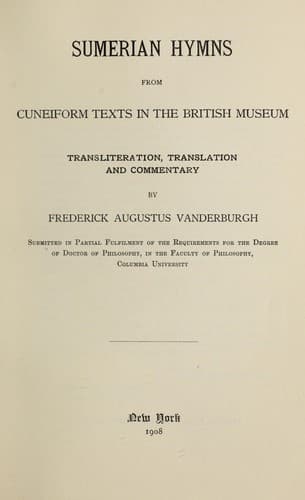
Sumerian Hymns from Cuneiform Texts in the British Museum — John Shaqi
Sumerian Hymns from Cuneiform Texts in the British Museum
Religion
Sumerian Hymns from Cuneiform Texts in the British Museum
Hymns, Sumerian; Sumerian language -- Texts
_mu-ni-ib-( )-ne-ne_: strangely enough the verb seems to be omitted in
the sentence of this line. Perhaps the omission is due to scribal error.
_mu_ is a verbal prefix of the third person here (see on line 18).
_ni-ib_ is a verbal infix (see MSL. p. XXXIII). The infixes are
generally personally indeterminate. They incorporate, between the verbal
prefixes that represent the subject and the verb, the object in
pronominal form, whether it be direct or indirect. _ni-ib_ really equals
“before it”. The translation disregards _ni-ib_ for the sake of
smoothness. _ni_ (see on line 13). _ib_ stands to _ni_ as postposition
to pronoun. The sign for _ib_ is old Babylonian; it is really composite
and signifies “side”. _ne-ne_ is a personal pronoun of the third person
(see ASK. p. 139). _ne_ is syllabic here (see _de_, line 6, about its
ideographic value; also _lam_, line 21).
22. _ḥu-e an-na ḥa-e ṭú-ra šà-nì ma-ni-ib-si_
The birds of the heavens and the fish of the sea are filled with
fear of thee!
_ḥu-e_ equals _i⋅⋅uru_, “bird”. _ḥu_: simple _ḥu_ is used elsewhere for
_i⋅⋅ûru_. The sign MUŠÊNNU here is old Babylonian. The archaic form is
supposed to be the picture of a bird in flight. _mušên_, another value
of MUŠÊNNU, also means “bird”. _e_ is not a necessary part of the word,
being here only a vowel of prolongation probably indicating the definite
article (see lines 3 and 14).
_an-na_ (see on line 18).
_ḥa-e_ equals _nûnu_, “fish”. _ḥa_ alone equals _nûnu_ (see on line 21).
_e_ serves the same purpose as in _ḥu-e_.
_ṭú-ra_ equals _apsû_, “sea”. _ṭú_ alone equals _apsû_ (Br. 10217). _ra_
may be taken as a sign of the genitive (see on line 3).
_šà-nì_ equals “in the midst of fear”. _šà_: ŠÂGU, with the value _šà_,
equal to _libbu_ or _kirbu_, is one of the few Sumerian prepositions. It
precedes its object as a noun in the construct state, _nì_ (see on line
18).
_ma-ni-ib-si_ consists of prefix, infix and verb. _ma_ is not a very
common verbal prefix. It is indeterminate, but the sense requires the
third person (see MSL. p. XXIV). _ni-ib_ is second person here (see on
line 21). _si_: the most common meaning of _si_ is _malû_, “fill”. The
sign is Babylonian and can be found either in the Code of Ḥammurabi or
the Cyrus Cylinder.
23. _a-a ^dimmer Mu-ul-lil-li da-da maḥ mu-e-gin sag-e-zi si-ba-e
e-nab_
O father Bêl, in great strength thou goest, the head of life, the
shepherd of the stars!
_a-a ^dimmer Mu-ul-lil-li_ (see on line 2). _li_ is merely phonetic
complement. We might give it an ideographic value and connect it with
_da-da_ and render “abundant in strength”. The common meaning of LILÛ is
_rašû_, “abound”. With the value _gub_, however, it means _ellu_,
“bright”. The sign is old Babylonian, yet quite different from the
archaic linear form.
_da-da_ means “strength” (see on line 16).
Public-domain text, read in full here on John Shaqi.
Reviews
Reviews
No reviews yet
Be the first to share your thoughts on this work.
Join the Discussion
Join the discussion
Sign in to leave a comment or review.
Sign InorCreate an account