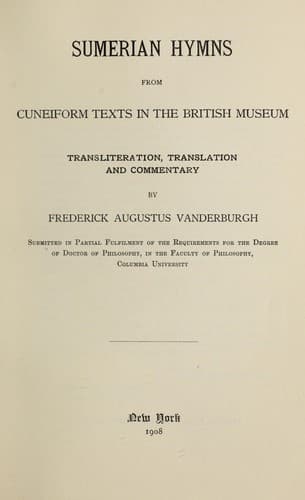
Sumerian Hymns from Cuneiform Texts in the British Museum — John Shaqi
Sumerian Hymns from Cuneiform Texts in the British Museum
Religion
Sumerian Hymns from Cuneiform Texts in the British Museum
Hymns, Sumerian; Sumerian language -- Texts
_i-i_: _i_ is the chief value of GIṬṬÛ. The sign with its five parallel
lines or wedges representing the five fingers of the hand is a symbol of
power. From the idea of “power”, we get that of “exaltation” (see Hymn
to Bêl, line 6).
_lugal-ra_ consists of stem _lugal_ and postposition _ra_ _lugal_: the
sign is composite, the elements being GAL and LU which mean “great” and
“man”. _lugal_ equals _šarru_ (Br. 4266). We shall have the element LU
with the ES value _mulu_. _ra_ (see Hymn to Bêl, lines 3 and 8). We
might expect _la_ here.
_û-de-eš_ consists of root _û_, phonetic complement _de_ and adverbial
ending _eš_. _û_ equals _ûmu_, “day”, (Br. 7797), and is a shortened
form of _ud_. _de_ is phonetic here. The more usual phonetic complement
of _ud_ is _da_ (see Br. 7774). _eš_ (see Br. 10001). _eš_ as an
adverbial ending is probably derived from the Semitic adverbial ending
_-iš_ which is supposed to have grown out of the Assyrian suffix of the
third person _šu_. Agglutinative languages do not often possess special
adverbial endings.
_mu-un-ê_ consists of verbal prefix _mu-un_ and verbal root _ê_. _mu-un_
is phonetic for _mun_ which is simply a nasalized _mu_ (see MSL. p.
XXVIII, and Hymn to Bêl, line 1). On _ê_ (see Hymn to Bêl, line 15).
18. _^dimmer Mu-ul-lil-li mu-du-ru û-sud-du šú-za ma-ra ni-in-rù_
Bêl with the sceptre of distant days exalts thy hand over the land.
_^dimmer Mu-ul-lil-li_ (see Hymn to Bêl, line 23).
_mu-du-ru_: there is a sign MUDRU (Br. 10776) which may be related to
PA. We may infer a relation between MUDRU and PA, because the two signs
have a common value _sig_. We know also that MU.DU.RU sometimes stands
for PA (Br. 1275). Now if MU.DU.RU can stand for PA it must have some
meaning in common with PA. The most usual meaning of PA is _ḥaṭṭu_,
“sceptre”, which gives good sense here. _mu_ (see Hymn to Bêl, line 1).
_du_ (see Hymn to Bêl, line 15).
_û-sud-du_ consists of noun _û_, adjective _sud_, and phonetic
complement _du_. _û_ (see line 17). _sud_ equals _rûḳu_, “distant” (Br.
7603). _du_ (see _gin_, line 23), phonetic complement here.
_šú-za_ equals noun _šú_ and suffix _za_. _šú_ (see Hymn to Bêl, line
25). _za_ is a suffix of the second person singular masculine (Br.
11722). We have had _za-e_ as being equal to “thou” (Hymn to Bêl, line
16). _zu_ we have found to be the more usual suffix of the second person
(see on line 6). _za_ is dialectic for _zu_.
_ma-ra_ (see on line 16).
_ni-in-rù_ consists of prefix _ni_, infix _in_ and verbal root _rù_.
_ni-in_ (see on line 16). _rù_ (see on line 14).
19. _Šis-unu-^ki-ma mà-gur azag-ga pa(d)-a-zu-ne_
When in Ur, O shining ship, thou speakest,
_Šis-unu-^ki-ma_ (see on line 2).
_mà-gur_ (see on line 1).
_azag-ga_ equals adjective _azag_, plus phonetic complement _ga_. _azag_
(see on line 1). _ga_ (see Hymn to Bêl, line 4).
_pa(d)-a-zu-ne_ (see on line 10).
20. _... ^dimmer Nu-dim-mud-e sal-dug-ga-zu-ne_
When to ... Ea thou speakest,
Public-domain text, read in full here on John Shaqi.
Reviews
Reviews
No reviews yet
Be the first to share your thoughts on this work.
Join the Discussion
Join the discussion
Sign in to leave a comment or review.
Sign InorCreate an account