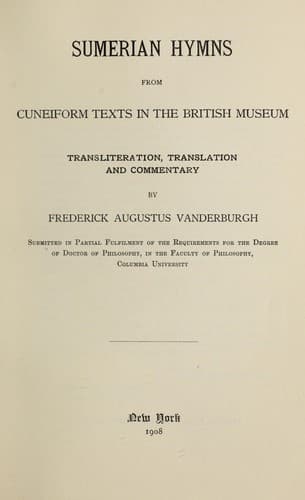
Sumerian Hymns from Cuneiform Texts in the British Museum — John Shaqi
Sumerian Hymns from Cuneiform Texts in the British Museum
Religion
Sumerian Hymns from Cuneiform Texts in the British Museum
Hymns, Sumerian; Sumerian language -- Texts
_^dimmer Nu-dim-mud-e_: we have here a compound ideogram as a name of
the god Ea. _^dimmer_ is determinative before the name of a god (see
Hymn to Bêl, line 2). _Nu-dim-mud_ equals the Assyrian E-a (Br. 2016).
The usual Sumerian ideogram is EN.KI. _e_ in _Nu-dim-mud-e_ a vowel of
prolongation (see Hymn to Bêl, line 3).
_sal-dug-ga-zu-ne_ (see line 15).
21. _......... [pa(d)]-a-zu[-ne]_
When ..... thou speakest,
_pa(d)-a-zu-ne_ (see line 10).
Reverse
22. .............
23. _...... la a im[-si]_
....... with water is filled
_a_ equals _mû_, “water” (Br. 11347). “Water” is a primary meaning of
the sign ÂU, which at first consisted of two short perpendicular lines
representing “falling water” (see Hymn to Bêl, line 3).
_im-si_ consists of indeterminate verbal prefix _im_ and verbal root
_si_. _im_ (Br. p. 545). _si_ (Hymn to Bêl, line 22).
24. _........ gi a im-si_
..... with water is filled.
_a im-si_ (see line 23).
25. _ìd ...... e a im-si ^dimmer [Šis-^ki-kam]_
The river .... is filled with water by Nannar.
_ìd_ equals _nâru_, “river”. Sometimes _ìd_ is shortened to _i_ (Br.
11647). The value _ìd_ comes from the union of two signs A “water” and
ṬÚ (Br. 10217). Moreover, ṬÚ with the value _ṭú_ equals _apsû_, “sea”.
The ṬÚ sign, explained more minutely, consists of ḤAL “run” inside of
KIL “enclosure”. So ḤAL + KIL = running, “flowing within an enclosure”,
hence = “sea”. While _ìd_ means primarily “water of the sea”, it is much
used also as a determinative before names of rivers. We have the name of
the Euphrates in the next line. Perhaps the name of the Tigris was given
in some one of the lines. The common Sumerian ideogram for the name of
the Tigris is _ḥal-ḥal_, an intensified form of _ḥal_, which means
“running” or “rushing”. The Tigris is thus very appropriately called
“the rushing river”. The Babylonian _Diglat_ in the hands of the
Persians took the form _Tigra_.
26. _azag-gi ìd ud-kib-nun-na-ge a im-si [^dimmer Šis-^ki-kam]_
The bright Euphrates is filled with water by Nannar.
_azag-gi_ equals _ellu_, “shining” (Br. 9901). _azag_ (see line 19).
_gi_ is a phonetic complement, chosen no doubt with a view to vowel
harmony as regards the following _ìd_ (?). GI as an ideogram means
“reed” (see Hymn to Bêl, line 24, _gín_).
Public-domain text, read in full here on John Shaqi.
Reviews
Reviews
No reviews yet
Be the first to share your thoughts on this work.
Join the Discussion
Join the discussion
Sign in to leave a comment or review.
Sign InorCreate an account