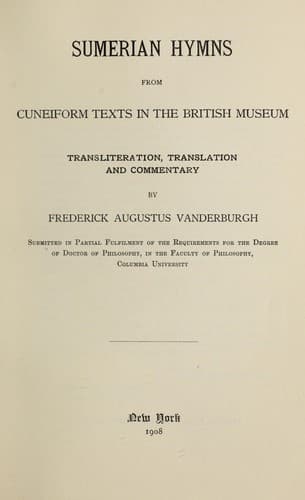
Sumerian Hymns from Cuneiform Texts in the British Museum
Religion
Sumerian Hymns from Cuneiform Texts in the British Museum
Hymns, Sumerian; Sumerian language -- Texts
_nì-ki-ge_: _nì_ is a value of IMMU equal to _puluḥtu_, “fear” (see Hymn
to Bêl, line 18). _ki_ equals _ir⋅itu_, “earth” (see Hymn to Bêl, line
9). _ge_ is a postpositive sign of the genitive (see Br. 5935.)
_bi-maḥ ḥad-ê-a mu-zu an-zak-ku_ (see lines 1 and 2).
5. _^dimmer Mer ù-mu-un ib-mal-la bi-maḥ ḥad-ê-a mu-zu an[-zak-ku]_
O Adad, lord of great wrath, in the mighty thunder and and the
lightning flash thou declarest thy name.
_ib-mal-la_: _ib_ is a value of TUM equal to _agâgu_, “anger” (Br.
4954). _mal_ is a value of IḲU which is dialectic for PISANNU and also
for MA.AL (see Hymn to Bêl, lines 1 and 18, and Hymn to Sin, line 2).
_ìb-mal_ = “wrathful” (Br. 2242).
_bi-maḥ ḥad-ê-a mu-zu an-zak-ku_ (see on lines 1 and 2).
6. _tab-tab-ba ù-mu-un dimmer ama-an-ki-ga bi-maḥ ḥad-ê-a [mu-zu
an-zak-ku]_
O twin, lord, bull-god of heaven and earth, in the mighty thunder
and the lightning flash thou declarest thy name.
_bar-tab-ba_ equals _tu’âmu_, “twin” (Br. 1896). _maš_ equals _tu’âmu_
(Br. 1811), while the cognate _bar_ equals _tappû_, “companion” (Br.
1807). _maš_, which represents the idea “cut”, is more primitive than
_bar_ which represents the idea “side”. _maš_ is also equal to _mâšu_,
“twin”, a Sumerian loan-word in Assyrian. _tab_ equals _tappû_ (Br.
3775). _tab_ may have been inserted, that _bar_ “companion” should be
taken rather than the narrower word “twin” (Hymn to Sin, line 16). _ba_
is a phonetic complement (Br. 102 and Hymn to Bêl, line 25). Adad is
called “twin” or “companion”, because he possessed a composite nature,
comprising in himself the elements of several gods. The manifestations
of power seen in wind and rain and in lightning and thunder, would
logically lead to the conclusion that his nature was divided, or that he
brought to his aid several gods endowed with powers suited to different
kinds of effort. The gods that aided Adad were sometimes looked upon as
birds, one of whom was the god Zû, who presided over the tempest. Zû’s
mother was Siris, lady of the rain and clouds. Then there was Martu, the
lord of the squall, and Barḳu, the genius of the lightning. The son of
Zû was a strong bull who pastured in the meadows, bringing abundance and
fertility. There was also Šûtu, the south wind. He, no doubt, was an
agent of Adad’s. There is another way in which Adad may be looked upon
as twin-like in his nature. He could pass suddenly from the fiercest
anger to gentlest kindness. He was represented in sculpture as carrying
a battle-axe. Kings invoked his aid against their enemies. In his
passionate rage he destroyed everything before him. When his wrath was
appeased, however, there might come the gentle breeze and the refreshing
shower. The fields which he had devastated he also caused to blossom and
produce fruit and grain.
_dimmer_ (see Hymn to Bêl, line 2).
Public-domain text, read in full here on John Shaqi.
Reviews
Reviews
No reviews yet
Be the first to share your thoughts on this work.
Join the Discussion
Join the discussion
Sign in to leave a comment or review.
Sign InorCreate an account