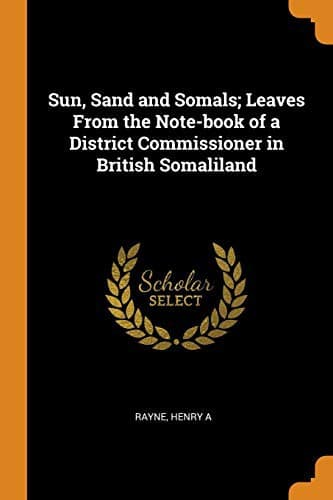
Sun, Sand and Somals: Leaves from the note-book of a District Commissioner in British SomalilandRayne, Henry A.
History
Sun, Sand and Somals: Leaves from the note-book of a District Commissioner in British Somaliland
Rayne, Henry A.
British Somaliland
What can I do for you I asked the old man. Buralli explains that
the Sultan sometimes visits the custom-house on an imaginary tour
of inspection. As a rule Harrichand, the customs superintendent,
is very good natured and puts up with the old man's nonsense. This
morning Harrichand was busy, and when the Sultan called could
spare him no time and became cross. Sultan Mahomed Haji Dideh was
summarily ejected onto the street.
Concerning this insubordinate conduct on the part of one of his
officers the old man is here now to complain. I look round the court
for inspiration. A crowd has collected near the door hoping to hear
the old fellow baited. He himself looks so dignified, so like what
he professes to be, that I have not the heart to hurt his feelings.
I seize his certificate of insanity, copy it, and hand it back,
saying that I have made a note of his complaint, and that it will be
attended to. The Sultan is sane enough to realise there is nothing
to be gained by prolonging the interview; he accepts his paper, bows
condescendingly, and, turning about, struts majestically out of
court.
I turn to the petitions.
"I most humbly beg to state," I read, "that one Abokr Fahia of
the Gadabursi, Abrian, had looted a pregnant she-camel from
Wais Kurmaneh of the Issa Rer Kul. And then, instead of this
she-camel, Issa Rer Kul had taken a camel from Abokr Fahia. Now
the Gadabursi Abrian want their camel from the Issa Rer Kul and
do not wish to settle the claim of the she-camel Issa Rer Kul. I
therefore pray your honour to order him, Akil Wairreh Yunis, who
filed the complaint, to restore the camel of the Issa Rer Kul.
By doing me this act of kindness I shall ever remain grateful.
Signed, Hersi Ahamed, his mark, of the Issa Rer Kul."
Now Wairreh Yunis is the Akil of the Abrian section of the Gadabursi
tribe, and Hersi Ahamed is the Akil of the Rer Kul Issa tribe. In
Political Case No. 17, of 1918, judgment was given against the Rer
Kul in favour of the Abrian for two camels, one of which had been
paid according to the Abrian statement, and the other remained as
yet unsettled for. This camel Wairreh Yunis was now demanding, and
Hersi Ahamed in his petition pleaded it was paid for by one camel
owed to the Rer Kul by the Abrian. Rather confusing but that was
what was meant. It will be observed in the petition above that the
camel taken from Wais Kurmaneh is described as having been pregnant.
When case No. 17, of 1918, was heard neither Hersi Ahamed nor Wais
Kurmaneh attended to defend it, hence judgment was given against
them in default. The present case, numbered sixty-seven of 1919,
however, brought some facts to light concerning this old case. It
would be hopeless to attempt to write down the tortuous statements
made by the various witnesses, and the following is what we arrived
at, after sifting the evidence, as a correct appreciation of the
origin of the dispute.
Public-domain text, read in full here on John Shaqi.
Reviews
Reviews
No reviews yet
Be the first to share your thoughts on this work.
Join the Discussion
Join the discussion
Sign in to leave a comment or review.
Sign InorCreate an account