Supplement to Harvesting Ants and Trap-Door Spiders — John Shaqi
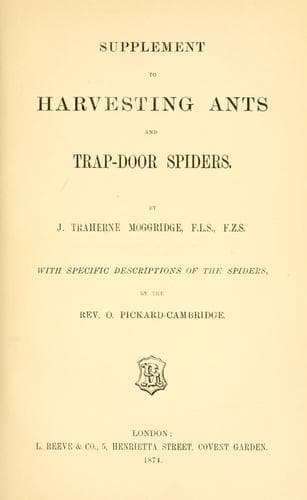
Supplement to Harvesting Ants and Trap-Door SpidersMoggridge, John Traherne
Science
Supplement to Harvesting Ants and Trap-Door Spiders
Moggridge, John Traherne
Ants; Trap-door spiders
In the case of _Pheidole megacephala_ (the only other European ant
which I have detected collecting seeds in large numbers), I have
never been able to find granaries or subterranean stores of any
kind, though I have frequently made extensive search for them, and
explored, to all appearance, the whole nest.
When we remember the great variety of ants which inhabit Europe alone
(a recent list[112] enumerating no fewer than 104 distinct species),
it certainly may seem strange at first that only two of their number
should possess this habit. Perhaps, however, we may yet discover
that some other of these species are true harvesters; but at present
the chances seem rather against it, since the harvesters found at
such distant points as Algiers, Cadenabbia, and Montpellier have all
turned out to belong to one or other of the two species, _structor_
or _barbara_.
[Footnote 112: _Description des Fourmis d'Europe pour servir à l'étude
des insectes myrmecophilis_, by Ernest André, in _Rev. et Mag. de
Zool._ 3^{e} ser. tom. ii. (1874), p. 152, &c.]
Indeed it may very well be that the numerical superiority and wide
distribution of these two species have served to secure to them a
more or less exclusive right to the habit of harvesting, for it
is clear that a given tract of country can only afford supplies of
grain to a limited number of colonies; so that, if these ants have
taken up the ground and are strong enough to maintain possession, no
others would have a chance. However this may be, I find that the more
insight I gain into the distinctive habits and relations of animals,
the more the belief impresses itself upon me that wherever we find
many closely-allied species inhabiting restricted areas, there we may
safely look for important differences among these species in respect
of their modes of life, and in the development of their instinct and
intelligence. And indeed this may be considered as a corollary of
the great law of natural selection, which uniformly tends to secure
the greatest possible amount of divergence in this respect, and to
prevent the co-existence in close proximity to each other of distinct
species having the same requirements and manner of life.
Public-domain text, read in full here on John Shaqi.
Reviews
Reviews
No reviews yet
Be the first to share your thoughts on this work.
Join the Discussion
Join the discussion
Sign in to leave a comment or review.
Sign InorCreate an account