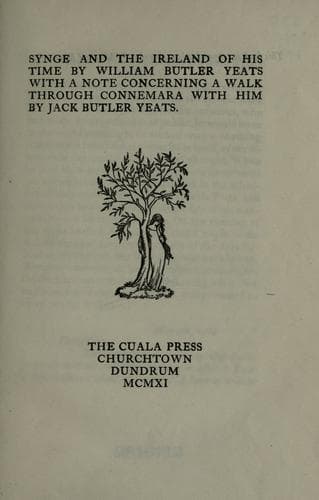
Synge and the Ireland of His TimeYeats, W. B. (William Butler)
General
Synge and the Ireland of His Time
Yeats, W. B. (William Butler)
Dramatists, Irish -- 20th century -- Biography; Synge, J. M. (John Millington), 1871-1909
Probably the pain inflicted was not great, yet the animals shut their
eyes and shrieked with almost human intonations, till the suggestion of
the noise became so intense that the men and women who were merely
looking on grew wild with excitement, and the pigs waiting their turn
foamed at the mouth and tore each other with their teeth.
After a while there was a pause. The whole slip was covered with amass
of sobbing animals, with here and there a terrified woman crouching
among the bodies and patting some special favourite, to keep it quiet
while the curraghs were being launched. Then the screaming began again
while the pigs were carried out and laid in their places, with a
waistcoat tied round their feet to keep them from damaging the canvas.
They seemed to know where they were going, and looked up at me over the
gunnel with an ignoble desperation that made me shudder to think that I
had eaten this whimpering flesh. When the last curragh went out, I was
left on the slip with a band of women and children, and one old boar
who sat looking out over the sea.
The women were over-excited, and when I tried to talk to them they
crowded round me and began jeering and shrieking at me because I am not
married. A dozen screamed at a time, and so rapidly that I could not
understand all they were saying, yet I was able to make out that they
were taking advantage of the absence of their husbands to give me the
full volume of their contempt. Some little boys who were listening
threw themselves down, writhing with laughter among the sea-weed, and
the young girls grew red and embarrassed and stared down in the surf.'
The book is full of such scenes. Now it is a crowd going by train to
the Parnell celebration, now it is a woman cursing her son who made
himself a spy for the police, now it is an old woman keening at a
funeral. Kindred to his delight in the harsh grey stones, in the
hardship of the life there, in the wind and in the mist, there is
always delight in every moment of excitement, whether it is but the
hysterical excitement of the women over the pigs, or some primary
passion. Once indeed, the hidden passion instead of finding expression
by its choice among the passions of others, shows itself in the most
direct way of all, that of dream. 'Last night,' he writes, at
Innismaan, 'after walking in a dream among buildings with strangely
intense light on them, I heard a faint rhythm of music beginning far
away on some stringed instrument.
It came closer to me, gradually increasing in quickness and volume with
an irresistibly definite progression. When it was quite near the sound
began to move in my nerves and blood, to urge me to dance with them.
I knew that if I yielded I would be carried away into some moment of
terrible agony, so I struggled to remain quiet, holding my knees
together with my hands.
Public-domain text, read in full here on John Shaqi.
Reviews
Reviews
No reviews yet
Be the first to share your thoughts on this work.
Join the Discussion
Join the discussion
Sign in to leave a comment or review.
Sign InorCreate an account