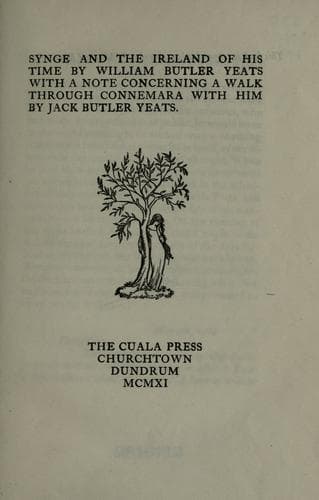
Synge and the Ireland of His TimeYeats, W. B. (William Butler)
General
Synge and the Ireland of His Time
Yeats, W. B. (William Butler)
Dramatists, Irish -- 20th century -- Biography; Synge, J. M. (John Millington), 1871-1909
The music increased continually, sounding like the strings of harps
tuned to a forgotten scale, and having a resonance as searching as the
strings of the 'cello.
Then the luring excitement became more powerful than my will, and my
limbs moved in spite of me.
In a moment I was swept away in a whirlwind of notes. My breath and my
thoughts and every impulse of my body became a form of the dance, till
I could not distinguish between the instrument or the rhythm and my own
person or consciousness. For a while it seemed an excitement that was
filled with joy; then it grew into an ecstasy where all existence was
lost in the vortex of movement. I could not think that there had been a
life beyond the whirling of the dance.
Then with a shock, the ecstasy turned to agony and rage. I struggled to
free myself but seemed only to increase the passion of the steps I
moved to. When I shrieked I could only echo the notes of the rhythm. At
last, with a movement of uncontrollable frenzy I broke back to
consciousness and awoke.
I dragged myself trembling to the window of the cottage and looked out.
The moon was glittering across the bay and there was no sound anywhere
on the island.'
XIII
In all drama which would give direct expression to reverie, to the
speech of the soul with itself, there is some device that checks the
rapidity of dialogue. When Oedipus speaks out of the most vehement
passions, he is conscious of the presence of the chorus, men before
whom he must keep up appearances 'children latest born of Cadmus' line'
who do not share his passion. Nobody is hurried or breathless. We
listen to reports and discuss them, taking part as it were in a council
of state. Nothing happens before our eyes. The dignity of Greek drama,
and in a lesser degree of that of Corneille and Racine depends, as
contrasted with the troubled life of Shakespearean drama, on an almost
even speed of dialogue, and on a so continuous exclusion of the
animation of common life, that thought remains lofty and language rich.
Shakespeare, upon whose stage everything may happen, even the blinding
of Gloster, and who has no formal check except what is implied in the
slow, elaborate structure of blank verse, obtains time for reverie by
an often encumbering Euphuism, and by such a loosening of his plot as
will give his characters the leisure to look at life from without.
Maeterlinck, to name the first modern of the old way who comes to
mind--reaches the same end, by choosing instead of human beings persons
who are as faint as a breath upon a looking-glass, symbols who can
speak a language slow and heavy with dreams because their own life is
but a dream. Modern drama, on the other hand, which accepts the
tightness of the classic plot, while expressing life directly, has been
driven to make indirect its expression of the mind, which it leaves to
be inferred from some common-place sentence or gesture as we infer it
in ordinary life; and this is, I believe, the cause of the perpetual
Public-domain text, read in full here on John Shaqi.
Reviews
Reviews
No reviews yet
Be the first to share your thoughts on this work.
Join the Discussion
Join the discussion
Sign in to leave a comment or review.
Sign InorCreate an account