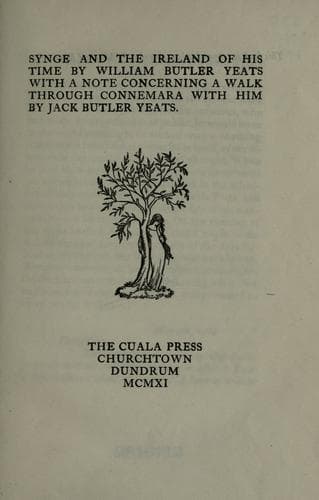
Synge and the Ireland of His TimeYeats, W. B. (William Butler)
General
Synge and the Ireland of His Time
Yeats, W. B. (William Butler)
Dramatists, Irish -- 20th century -- Biography; Synge, J. M. (John Millington), 1871-1909
disappointment of the hope imagined this hundred years that France or
Spain or Germany or Scandinavia will at last produce the master we
await.
The divisions in the arts are almost all in the first instance
technical, and the great schools of drama have been divided from one
another by the form or the metal of their mirror, by the check chosen
for the rapidity of dialogue. Synge found the check that suited his
temperament in an elaboration of the dialects of Kerry and Aran. The
cadence is long and meditative, as befits the thought of men who are
much alone, and who when they meet in one another's houses--as their
way is at the day's end--listen patiently, each man speaking in turn
and for some little time, and taking pleasure in the vaguer meaning of
the words and in their sound. Their thought, when not merely practical,
is as full of traditional wisdom and extravagant pictures as that of
some Aeschylean chorus, and no matter what the topic is, it is as
though the present were held at arms length. It is the reverse of
rhetoric, for the speaker serves his own delight, though doubtless he
would tell you that like Raftery's whiskey-drinking it was but for the
company's sake. A medicinal manner of speech too, for it could not even
express, so little abstract it is and so rammed with life, those worn
generalizations of national propaganda. 'I'll be telling you the finest
story you'd hear any place from Dundalk to Ballinacree with great
queens in it, making themselves matches from the start to the end, and
they with shiny silks on them ... I've a grand story of the great
queens of Ireland, with white necks on them the like of Sarah Casey,
and fine arms would hit you a slap.... What good am I this night, God
help me? What good are the grand stories I have when it's few would
listen to an old woman, few but a girl maybe would be in great fear the
time her hour was come, or a little child wouldn't be sleeping with the
hunger on a cold night.' That has the flavour of Homer, of the Bible,
of Villon, while Cervantes would have thought it sweet in the mouth
though not his food. This use of Irish dialect for noble purpose by
Synge, and by Lady Gregory, who had it already in her Cuchulain of
Muirthemne, and by Dr. Hyde in those first translations he has not
equalled since, has done much for National dignity. When I was a boy I
was often troubled and sorrowful because Scottish dialect was capable
of noble use, but the Irish of obvious roystering humour only; and this
error fixed on my imagination by so many novelists and rhymers made me
listen badly. Synge wrote down words and phrases wherever he went, and
with that knowledge of Irish which made all our country idioms easy to
his hand, found it so rich a thing, that he had begun translating into
it fragments of the great literatures of the world, and had planned a
complete version of the Imitation of Christ. It gave him imaginative
richness and yet left to him the sting and tang of reality. How vivid
Public-domain text, read in full here on John Shaqi.
Reviews
Reviews
No reviews yet
Be the first to share your thoughts on this work.
Join the Discussion
Join the discussion
Sign in to leave a comment or review.
Sign InorCreate an account