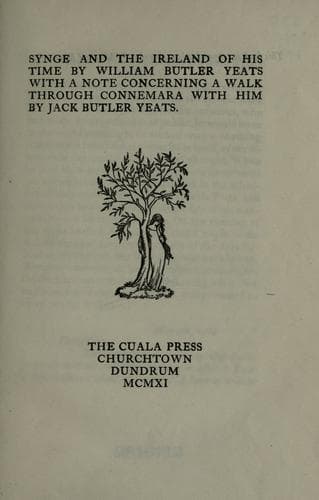
Synge and the Ireland of His TimeYeats, W. B. (William Butler)
General
Synge and the Ireland of His Time
Yeats, W. B. (William Butler)
Dramatists, Irish -- 20th century -- Biography; Synge, J. M. (John Millington), 1871-1909
in his translation from Villon are those 'eyes with a big gay look out
of them would bring folly from a great scholar.' More vivid surely than
anything in Swinburne's version, and how noble those words which are
yet simple country speech, in which his Petrarch mourns that death came
upon Laura just as time was making chastity easy, and the day come when
'lovers may sit together and say out all things arc in their hearts,'
and 'my sweet enemy was making a start, little by little, to give over
her great wariness, the way she was wringing a sweet thing out of my
sharp sorrow.'
XIV
Once when I had been saying that though it seemed to me that a
conventional descriptive passage encumbered the action at the moment of
crisis. I liked 'The Shadow of the Glen' better than 'Riders to the
Sea' that is, for all the nobility of its end, its mood of Greek
tragedy, too passive in suffering; and had quoted from Matthew Arnold's
introduction to 'Empedocles on Etna,' Synge answered, 'It is a curious
thing that "The Riders to the Sea" succeeds with an English but not
with an Irish audience, and "The Shadow of the Glen" which is not liked
by an English audience is always liked in Ireland, though it is
disliked there in theory.' Since then 'The Riders to the Sea' has grown
into great popularity in Dublin, partly because with the tactical
instinct of an Irish mob, the demonstrators against 'The Playboy' both
in the press and in the theatre, where it began the evening, selected
it for applause. It is now what Shelley's 'Cloud' was for many years, a
comfort to those who do not like to deny altogether the genius they
cannot understand. Yet I am certain that, in the long run, his
grotesque plays with their lyric beauty, their violent laughter, 'The
Playboy of the Western World' most of all, will be loved for holding so
much of the mind of Ireland. Synge has written of 'The Playboy' 'anyone
who has lived in real intimacy with the Irish peasantry will know that
the wildest sayings in this play are tame indeed compared with the
fancies one may hear at any little hillside cottage of Geesala, or
Carraroe, or Dingle Bay.' It is the strangest, the most beautiful
expression in drama of that Irish fantasy, which overflowing through
all Irish Literature that has come out of Ireland itself (compare the
fantastic Irish account of the Battle of Clontarf with the sober Norse
account) is the unbroken character of Irish genius. In modern days this
genius has delighted in mischievous extravagance, like that of the
Gaelic poet's curse upon his children, 'There are three things that I
hate, the devil that is waiting for my soul, the worms that are waiting
for my body, my children, who are waiting for my wealth and care
neither for my body nor my soul: Oh, Christ hang all in the same
noose!' I think those words were spoken with a delight in their
vehemence that took out of anger half the bitterness with all the
gloom. An old man on the Aran Islands told me the very tale on which
Public-domain text, read in full here on John Shaqi.
Reviews
Reviews
No reviews yet
Be the first to share your thoughts on this work.
Join the Discussion
Join the discussion
Sign in to leave a comment or review.
Sign InorCreate an account