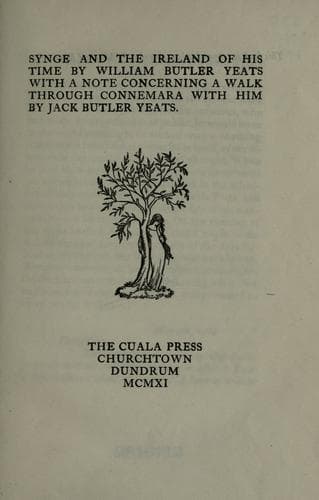
Synge and the Ireland of His TimeYeats, W. B. (William Butler)
General
Synge and the Ireland of His Time
Yeats, W. B. (William Butler)
Dramatists, Irish -- 20th century -- Biography; Synge, J. M. (John Millington), 1871-1909
To speak of one's emotions without fear or moral ambition, to come out
from under the shadow of other men's minds, to forget their needs, to
be utterly oneself, that is all the Muses care for. Villon, pander,
thief, and man-slayer, is as immortal in their eyes, and illustrates in
the cry of his ruin as great a truth as Dante in abstract ecstasy, and
touches our compassion more. All art is the disengaging of a soul from
place and history, its suspension in a beautiful or terrible light, to
await the Judgement, and yet, because all its days were a Last Day,
judged already. It may show the crimes of Italy as Dante did, or Greek
mythology like Keats, or Kerry and Galway villages, and so vividly that
ever after I shall look at all with like eyes, and yet I know that Cino
da Pistoia thought Dante unjust, that Keats knew no Greek, that those
country men and women are neither so lovable nor so lawless as 'mine
author sung it me;' that I have added to my being, not my knowledge.
XV
I wrote the most of these thoughts in my diary on the coast of
Normandy, and as I finished came upon Mont Saint Michel, and thereupon
doubted for a day the foundation of my school. Here I saw the places of
assembly, those cloisters on the rock's summit, the church, the great
halls where monks, or knights, or men at arms sat at meals, beautiful
from ornament or proportion. I remembered ordinances of the Popes
forbidding drinking-cups with stems of gold to these monks who had but
a bare dormitory to sleep in. Even when imagining, the individual had
taken more from his fellows and his fathers than he gave; one man
finishing what another had begun; and all that majestic fantasy,
seeming more of Egypt than of Christendom, spoke nothing to the
solitary soul, but seemed to announce whether past or yet to come an
heroic temper of social men, a bondage of adventure and of wisdom. Then
I thought more patiently and I saw that what had made these but as one
and given them for a thousand years the miracles of their shrine and
temporal rule by land and sea, was not a condescension to knave or
dolt, an impoverishment of the common thought to make it serviceable
and easy, but a dead language and a communion in whatever, even to the
greatest saint, is of incredible difficulty. Only by the substantiation
of the soul I thought, whether in literature or in sanctity, can we
come upon those agreements, those separations from all else that fasten
men together lastingly; for while a popular and picturesque Burns and
Scott can but create a province, and our Irish cries and grammars serve
some passing need, Homer, Shakespeare, Dante, Goethe and all who travel
in their road with however poor a stride, define races and create
everlasting loyalties. Synge, like all of the great kin, sought for the
race, not through the eyes or in history, or even in the future, but
where those monks found God, in the depths of the mind, and in all art
Public-domain text, read in full here on John Shaqi.
Reviews
Reviews
No reviews yet
Be the first to share your thoughts on this work.
Join the Discussion
Join the discussion
Sign in to leave a comment or review.
Sign InorCreate an account