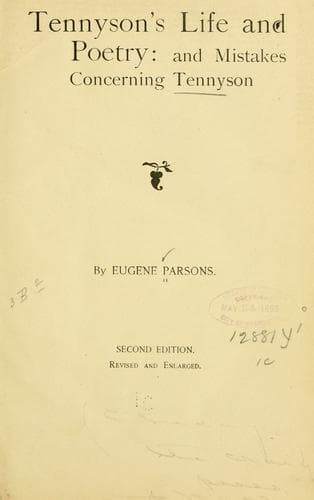
Tennyson's Life and Poetry: And Mistakes Concerning Tennyson — John Shaqi
Tennyson's Life and Poetry: And Mistakes Concerning TennysonParsons, Eugene
General
Tennyson's Life and Poetry: And Mistakes Concerning Tennyson
Parsons, Eugene
Tennyson, Alfred Tennyson, Baron, 1809-1892
From first to last Alfred Tennyson has recognized that the mission of the
poet is that of an æsthetic teacher. Much has he done to educate
English-speaking people in the appreciation of beauty. But he is
emphatically more than this. A man of stainless reputation, his deeds and
words have almost invariably been on the side of righteousness. His career
has been free from the excesses which disgraced the lives of Marlowe and
Shelley, of Byron and Poe. He is rather to be ranged with the Spensers and
Miltons, the Wordsworths and Brownings, as a defender of truth and
religion. In the main he has steadfastly kept in mind the austere ideal--
Of those who, far aloof
From envy, hate and pity, and spite and scorn,
Live the great life which all our greatest fain
Would follow, center'd in eternal calm.
II.
The current of Tennyson's genius is like a rivulet placidly flowing
through meadows and groves, occasionally rippling and swirling over
stones, then pursuing its even course--gradually widening and deepening;
not like a mighty river proudly sweeping in a resistless flood through a
wilderness, or tumbling down rocky chasms. All that he has given the world
during sixty years of literary activity is contained in less than a dozen
volumes of verse. Only a rapid survey of his poetical career is attempted
here.
Passing by without comment _Poems by two Brothers_ (1826), "The Lover's
Tale" (composed about 1828), and "Timbuctoo" (1829), we come to Tennyson's
first bid for fame in _Poems, chiefly Lyrical_ (1830). This slender volume
included (along with much rubbish) a few pieces which are perennial
favorites with lovers of Tennyson, viz.: "Mariana," "Recollections of the
Arabian Nights," "The Dying Swan," "A Dirge," "Love and Death," and
"Circumstance." Among the poems suppressed in later editions is one in an
unusual vein--"Nero to Leander"--which Emerson inserted in his
_Parnassus_.
His second book of _Poems_ (1833) was a more ambitious venture. Its
contents, though marred by faults of crude taste, possessed in a marked
degree, the characteristic qualities of the Laureate's poetry. Nearly all
of the lyrics in it have been found worthy of a permanent place in the
collected editions of his poems, but most of them underwent countless
changes before they were republished in 1842--being corrected and polished
till they were well-nigh perfect from a critical standpoint.
The two volumes of _Poems_ (1842) revealed Tennyson at his best--a mature
singer whose dignified, harmonious verse compares favorably with the most
splendid contributions to British poetry. "The Princess" (1847), "In
Memoriam" (1850), and "Maud" (1855) made his position secure as the
greatest of living poets.
Public-domain text, read in full here on John Shaqi.
Reviews
Reviews
No reviews yet
Be the first to share your thoughts on this work.
Join the Discussion
Join the discussion
Sign in to leave a comment or review.
Sign InorCreate an account