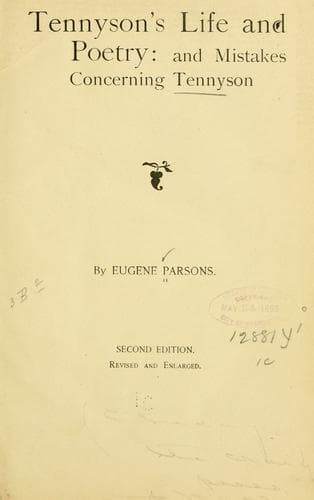
Tennyson's Life and Poetry: And Mistakes Concerning TennysonParsons, Eugene
General
Tennyson's Life and Poetry: And Mistakes Concerning Tennyson
Parsons, Eugene
Tennyson, Alfred Tennyson, Baron, 1809-1892
Not satisfied to rest content as a lyrist, Tennyson essayed extended
narrative in _Idyls of the King_ (1859) and "Enoch Arden" (1864). Gaining
courage from the enthusiastic reception of the four Arthurian idyls, he
undertook to carry out a long cherished design--which Milton and Dryden
had conceived--of writing a national epic on King Arthur. He had already
made several attempts at versifying incidents from the _Mabinogion_ and
Malory's old romance _Morte d' Arthur_, but they were isolated fragments.
From time to time he added others, making the series of tales called the
Round Table a complete cycle as follows:
The Coming of Arthur, 1869; Gareth and Lynette, 1872; Geraint and Enid,
1859; Balin and Balan, 1885; Merlin and Vivien, 1859; Lancelot and Elaine,
1859; The Holy Grail, 1869; Pelleas and Ettarre, 1869; The Last
Tournament, 1871; Guinevere, 1859; The Passing of Arthur, 1842, 1869.
Then boldly entering the dangerous field of historical drama, Tennyson
became a rival of Shakspeare himself in "Queen Mary"[14] (1875), "Harold"
(1876), and "Becket" (1884). Besides these, he brought forth three shorter
plays or dramatic sketches--"The Cup"[15] (1884), "The Falcon"[16] (1884),
"The Promise of May"[17] (1886), and a lengthy idyllic drama called "The
Foresters"[18] (1892).
As if to prove that his fertility was not exhausted in the province of the
lyric, he made fresh incursions into fields of song long familiar to him.
These winnowings of the last two decades are gathered into the following
volumes:
_Ballads, and Other Poems_ (1880); _Tiresias, and Other Poems_ (1885);
_Locksley Hall Sixty Years After, etc._ (1886); _Demeter, and Other Poems_
(1889).
Enough books have been named to give at least half a dozen minstrels a
firm footing on Parnassus. The number of Tennyson's meritorious
performances is simply astonishing. But few poets have wrought with such
unwearying patience. Not many can present as imposing a catalogue of works
that are confessedly of such a high order of excellence. Browning has
written more, but Browning has not taken the trouble to perfect himself in
form--in short, he is not a finished artist. In literary workmanship,
Tennyson stands supreme. It is universally admitted that none of his
contemporaries ranks so high as man of letters. He is the brightest
ornament of the Victorian reign.
Public-domain text, read in full here on John Shaqi.
Reviews
Reviews
No reviews yet
Be the first to share your thoughts on this work.
Join the Discussion
Join the discussion
Sign in to leave a comment or review.
Sign InorCreate an account