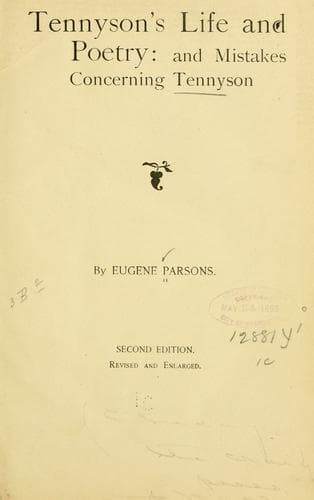
Tennyson's Life and Poetry: And Mistakes Concerning TennysonParsons, Eugene
General
Tennyson's Life and Poetry: And Mistakes Concerning Tennyson
Parsons, Eugene
Tennyson, Alfred Tennyson, Baron, 1809-1892
Without doubt the Laureate deserves his hard-won glory. In his hale old
age, he has disarmed the critics of years ago who sneered at his empty
lays and feminine ways. The question--_Cui bono?_ could be asked as to
many of Tennyson's earlier efforts, such as "Oriana," "The Lady of
Shalott," "Audley Court," "Edwin Morris," "Amphion," "Lady Clare," "The
Lord of Burleigh," "The Beggar Maid" and others. These lyrics and idyls
are made up of ornate commonplaces which show the artistic instinct rather
than the poetic. They abound with the ephemeral conceits of drawing-room
poetry. They contain nothing that resembles vivacity or sublimity. They
have not the interest which is general and universal as distinguished from
the private or the unusual. They are not representative of human nature,
but of individual peculiarities. They are ideal pictures, not transcripts
from experience.
With a few exceptions, the minor poems published in 1855 and 1864 are of
similar character; and it may be said that "The Princess," "Maud," "Enoch
Arden," and most of the Arthurian stories are in much the same vein. None
of these works, when viewed as an organic whole, can be called great. In
all of them, manliness is at a discount, and there is withal a dearth of
ideas. Sentiment and ornament are overdone, and there is not enough of
life. They can be described as a chaos of pretty fancies and idle
reveries. Such are not the strains that shape a nation's destiny and are
treasured in its heart. In the centuries agone, such a songster would have
been a first-class troubadour, much sought and praised in princely
circles.
But former estimates of Tennyson must be revised. The slurs at the
euphonious jingler and effeminate Alfred are in place no more. He has
abandoned the domain of the legendary and the fantastic. Romance has given
way to history, and dreams to reality. Sensuous effects are now
subordinate. His verse no longer cloys with sweetness. It is simple,
natural, impassioned.
Public-domain text, read in full here on John Shaqi.
Reviews
Reviews
No reviews yet
Be the first to share your thoughts on this work.
Join the Discussion
Join the discussion
Sign in to leave a comment or review.
Sign InorCreate an account