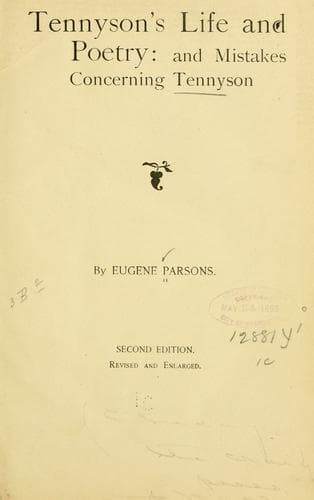
Tennyson's Life and Poetry: And Mistakes Concerning TennysonParsons, Eugene
General
Tennyson's Life and Poetry: And Mistakes Concerning Tennyson
Parsons, Eugene
Tennyson, Alfred Tennyson, Baron, 1809-1892
"Queen Mary" and "Becket" certainly rank foremost among the few powerful
plays that have appeared since Shelley wrote "The Cenci." There are some
Bulwer-Lyttonish passages in "Becket," but they are more than redeemed by
the imperial magnificence of other passages in the same tragedy. The
ballads and other lyrics published within the last dozen years display a
rugged virility that was quite foreign to the labored "Idyls of the King."
"Rizpah" and "The Revenge" have the ring of genuine metal. There is no
hollow sound in the manly tributes to E. Fitzgerald and to his ancient
Mantuan master. The introspective poet of "The Two Voices" has grown to
fuller intellectual stature in "The Ancient Sage." The music and majesty
of "Tiresias" and "Demeter" are unsurpassed in "Ulysses" and "Tithonus."
"Romney's Remorse" excels "Sea Dreams" in portraying the better instincts
of humanity on the domestic side, and its tender lullaby--"Beat upon mine,
little heart!"--almost equals the incomparable "Sweet and low." While
"Vastness" and "Crossing the Bar" repeat the lyrical triumphs of his
palmiest days.
Time has dealt gently with the venerable harper, whose hands sweep the
strings with surer touch and greater compass than before. Age has brought
more forceful speech and clearer vision. Some of his senile efforts betray
less of conscious effort, as though long practice in using metrical
language as a vehicle of thought and imagery had made it a pure mirror of
the poet's mind. His worn-out mannerisms appear occasionally, also his
subtleties of expression and feeling. There is the same imaginative
sorcery as of old, and the same consummate style, but the studied elegance
and artful devices of earlier productions are less noticeable. There is
less of minute finish in form and more of epic grandeur in tone and
spirit. A healthier inspiration has visited him in the evening of life.
His genius has gradually ripened. The full cup of advanced years was
needed to bring out what was best in him, to effect his complete
development.
Since the hysterical explosion of "Locksley Hall Sixty Years After," the
Laureate seems to have attained the calmness of soul which belongs to the
true poetical spirit. He is no longer the fretful author of "The New
Timon," "The Spiteful Letter," and "Literary Squabbles," who lacked the
restraint of entire self-possession. A more serious tone pervades the
personal poems--"To Ulysses," "To Mary Boyle" and others in his 1889
volume. A wiser man wrote the stately measures of "Happy" and "By an
Evolutionist," one who looked down upon past follies from spiritual
heights never before reached. There is a touch of Miltonic loftiness in
his "Parnassus," and the philosophic resignation of Goethe in "The
Progress of Spring." His is the tranquil, fruitful old age that crowns a
well ordered career.
MISTAKES CONCERNING TENNYSON.
A STUDY IN CONTEMPORANEOUS BIOGRAPHY.
Public-domain text, read in full here on John Shaqi.
Reviews
Reviews
No reviews yet
Be the first to share your thoughts on this work.
Join the Discussion
Join the discussion
Sign in to leave a comment or review.
Sign InorCreate an account