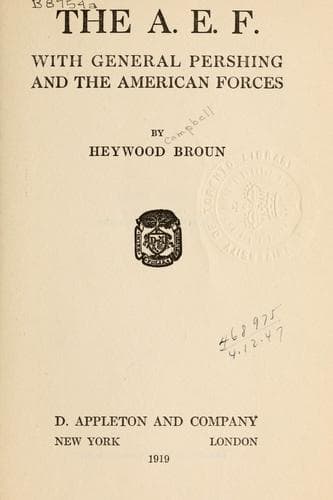
The A. E. F.: With General Pershing and the American ForcesBroun, Heywood
History
The A. E. F.: With General Pershing and the American Forces
Broun, Heywood
United States. Army. American Expeditionary Forces; World War, 1914-1918 -- Personal narratives
There are certain military reasons for not naming units and not naming
individuals, but the war is not being fought by the army alone. If the
country is to be enlisted to its fullest capacity it must have names.
The national character cannot be changed in a few months or a year. The
newspapers have brought us up on names. It is too much to expect that
the folk back home can keep up on their toes if the men they know go
away into a great silence as soon as they cross the ocean and are not
heard of again unless their names appear in casualty lists. We can't do
less for our war heroes than we have done for Ty Cobb and Christy
Mathewson and Smokey Joe Wood. That is not only for the sake of the
people back home, but for those at the front as well. They like to know
that people are hearing about them. It is not encouraging to them to
receive papers and learn that "certain units have done something." Just
as soon as possible they want to see the name of their regiment and of D
company and K and F and H. The English name their units after a battle
and so must we. And we must have plenty of names. It helped Ty Cobb not
a little in the business of being Ty that thousands of columns of
newspaper space had built up a tradition behind him. When Joe Wood got
in a hole it is more than probable that he realized that he must and
would get himself out again because he was "Smokey Joe." We must do as
much for private Alexander Brown and corporal James Kelly, and for
sergeants and major generals, too. We are not a folk who thrive on
reticence. It is true that we like to blow our own horn but it must be
remembered that Joshua brought down a great fortress in that manner. The
trumpets are needed for America. We cannot fight our best to the sound
of muffled drums.
The man abroad who is sending back the stories of the war must deal with
the French censor as well as the American, and that reminds us of
Pétain's mustache. When the great general came to our camp all the
newspaper stories about his visit were sent to the French military
censor. All were allowed to pass in due course except one. The
correspondent concerned went around to find out what was wrong.
"I'm sorry," said the censor, "but I cannot allow this cable message to
go in its present form. You have spoken of General Pétain's white
mustache. I might stretch a point and allow you to say General Pétain's
gray mustache, but I should much prefer to have you say General Pétain's
blonde mustache."
"Make it green with small purple spots, if you like," said the
correspondent, "but let my story go."
CHAPTER X
MARINES
"They tell me," said a young marine in his best confidential and earnest
manner, "that the Kaiser isn't afraid of the American army, but that he
is afraid of the marines."
Public-domain text, read in full here on John Shaqi.
Reviews
Reviews
No reviews yet
Be the first to share your thoughts on this work.
Join the Discussion
Join the discussion
Sign in to leave a comment or review.
Sign InorCreate an account