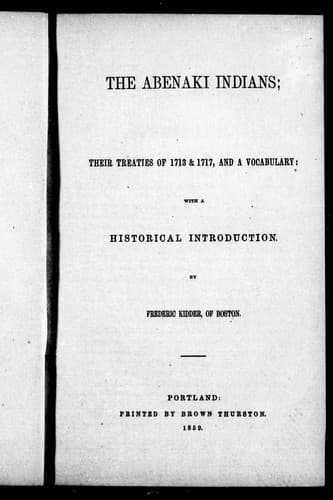
The Abenaki Indians: Their Treaties of 1713 & 1717, and a VocabularyKidder, Frederic
History
The Abenaki Indians: Their Treaties of 1713 & 1717, and a Vocabulary
Kidder, Frederic
Abenaki Indians; Abenaki Indians -- Treaties; Abenaki language
As they inhabited fertile intervale land, they gave more attention to
agriculture than any of the neighboring tribes, and appear to have been
originally more peaceably inclined towards the whites than some of their
neighbors. Residing so far inland, they were but little acquainted with
the prowess of the whites, and sent out their war parties to commit
murders and depredations on the unprotected settlers, without expecting
a retribution on their own heads. After a long succession of murders and
captures in the English settlements, by this tribe, instigated, as was
believed, by their priest, Sebastian Rasle, an expedition was sent
against them, consisting of about two hundred men, who killed about
thirty Indians, including Rasle, and destroyed the place, without the
loss of a man. This broke their power, but they continued to reside
there for many years, and gradually retired to the St. Francis,--the
last family migrating near the end of the last century.
The Assagunticooks were a numerous tribe who inhabited the country along
the whole valley of the Androscoggin; and although their lands were not
occupied by whites, they were frequently bitter enemies, and were the
first to begin a war and the last to make peace. Their location gave
them easy access to the settlements, from Casco to Piscataqua, which
they improved to glut their thirst for blood and slaughter. About 1750
they moved to Canada and joined the St. Francis tribe. They could then
muster about one hundred and fifty warriors, and being much the most
numerous tribe that emigrated there, it is supposed they had the
greatest influence, and that their dialect is more truly perpetuated
than any other in that confederacy.
The Sokokis inhabited the country bordering on the Saco River, but were
mostly limited to its head waters. Their villages were located on the
alluvial lands in what is now Fryeburg, Me., and Conway, N. H. The
Pegwakets and Ossipees were either identical with or branches of this
tribe. In 1725 Capt. John Lovewell with about fifty soldiers, on a
scouting adventure in the vicinity, fell in with a war party of the
tribe, and a sanguinary battle ensued, disastrous to both parties. Their
chief, Paugus, was slain; and within a short period the remainder of
the tribe, dispirited by their misfortunes, retired to Canada.
Public-domain text, read in full here on John Shaqi.
Reviews
Reviews
No reviews yet
Be the first to share your thoughts on this work.
Join the Discussion
Join the discussion
Sign in to leave a comment or review.
Sign InorCreate an account