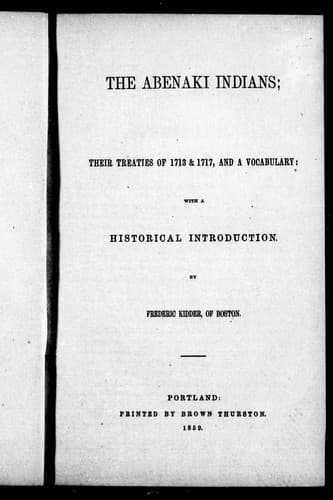
The Abenaki Indians: Their Treaties of 1713 & 1717, and a Vocabulary — John Shaqi
The Abenaki Indians: Their Treaties of 1713 & 1717, and a VocabularyKidder, Frederic
History
The Abenaki Indians: Their Treaties of 1713 & 1717, and a Vocabulary
Kidder, Frederic
Abenaki Indians; Abenaki Indians -- Treaties; Abenaki language
The Pennacooks were probably the only occupants of the waters of the
Merrimac, and perhaps included nearly all the nations who resided in
what is now the State of New Hampshire. Their principal residence was at
Amoskeag Falls, the site of the present manufacturing city of
Manchester. It is usual to name the Pennatuckets, Wambesitts, Souhegans,
and some others as tribes, but there can be no doubt they all owned
fealty to the head sagamore of the Pennacooks, and were only branches of
that tribe, as were all the Indians on the Piscataqua and its waters. It
is also probable the small band of Cowasacks, on the upper Connecticut,
were of this tribe. The Pennacooks must have been at one time a numerous
community, and were less warlike than any of the Abenaki race. It is
likely they were more disposed to cultivate the soil, and their
historian, Judge Potter, represents them as amiable and friendly to the
whites. Notwithstanding, they were the earliest emigrants to Canada.
They left their pleasant hunting grounds with regret, and often returned
to cultivate their ancient fields; but few of them resided permanently
there after about 1700.
It is proper to add to the names of the original Abenaki tribes, that of
the Malacite or Amalecite, who have always resided on the St. John. It
is not known that any part of this tribe emigrated to Canada with those
of Maine, but in 1828 about thirty families emigrated there, and settled
on a branch of the River Verte. But the largest part still reside in New
Brunswick.
We come now to trace the emigration of the Abenakis to the banks of the
St. Lawrence. As the Jesuits had been in constant communication with the
tribes in Maine for more than half a century, the Indians had learned
the way to Quebec, and it is probable that during Philip's war some of
the tribes obtained arms and ammunition from that place. During this war
the Pennacooks, under the influence of their chief, Wonnolancet, had
remained neutral, and in July, 1676, at Chocheco, signed with some
others a treaty of perpetual peace. Still, the feeling of the whites was
so strong against all the race, that they placed little reliance on
their former good conduct or present promises. A few months after this
treaty, they induced a large number of Indians, from the various tribes,
to come to the same place, and where all the militia of the provinces
had assembled, and while professing to practice some sham evolutions,
the Indians were suddenly surrounded and captured. Many of the prisoners
so treacherously obtained were executed, and others sold into slavery
for having been in arms against the whites.
Public-domain text, read in full here on John Shaqi.
Reviews
Reviews
No reviews yet
Be the first to share your thoughts on this work.
Join the Discussion
Join the discussion
Sign in to leave a comment or review.
Sign InorCreate an account