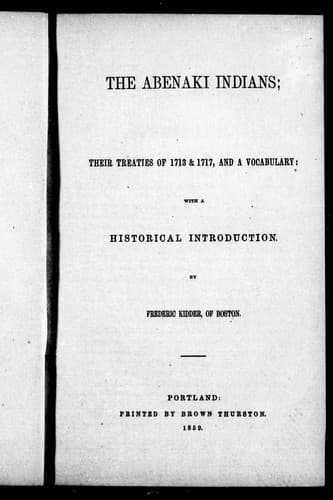
The Abenaki Indians: Their Treaties of 1713 & 1717, and a Vocabulary — John Shaqi
The Abenaki Indians: Their Treaties of 1713 & 1717, and a VocabularyKidder, Frederic
History
The Abenaki Indians: Their Treaties of 1713 & 1717, and a Vocabulary
Kidder, Frederic
Abenaki Indians; Abenaki Indians -- Treaties; Abenaki language
Although Wonnolancet and his tribe were discharged, this breach of faith
must have taught him that he could not rely on the white man's promise,
and that neither he nor his tribe was safe on the Merrimac. With this
feeling he, with a part of them, left for Canada in the autumn of 1677.
Although he subsequently returned to visit his former hunting and
fishing grounds, his real home was, for the remainder of his life, near
Quebec, and he with his band became the nucleus of the Indian settlement
there; but it is not apparent that he was at any period the enemy of the
English.
In the course of the war, nearly all the tribes in New England had been
more or less involved in it. The colonists now looked upon them as a
conquered race of heathen, and that their duty was to drive them out,
and enjoy their lands in the manner of the Israelites of old. On the
other hand, the Indians who had made terms of peace, having now for the
first time realized that they had not the ability to cope with the
English in war, and could not trust their friendship in peace, naturally
looked to the French as the protectors of their villages and hunting
grounds. Many of them were willing to place themselves and their
families under their care.
Therefore the Jesuits, who had for a long time been their spiritual, and
often their temporal advisers, began to turn the steps of the broken and
scattered remnants of the tribes who had suffered most in the war, to
the feeble settlement of the Pennacooks, near Quebec, and as early as
1685, the Governor of that colony granted a tract of land at a place
called Côte de Lauzon, opposite that city, for their use. Up to the
commencement of the war, a considerable number of Indians had continued
to reside on the Connecticut river, above Northampton; they had fought
against the whites, and at the death of Philip, fled and took up their
abode at Scauticook, above Albany, and were afterwards increased by
additions from other tribes.
After a few years, the government of New York became desirous of being
rid of such neighbors, whom they could not trust or control, and induced
them to remove to Canada, where most of them were settled before the
close of that century, with or near the Pennacooks.
Public-domain text, read in full here on John Shaqi.
Reviews
Reviews
No reviews yet
Be the first to share your thoughts on this work.
Join the Discussion
Join the discussion
Sign in to leave a comment or review.
Sign InorCreate an account