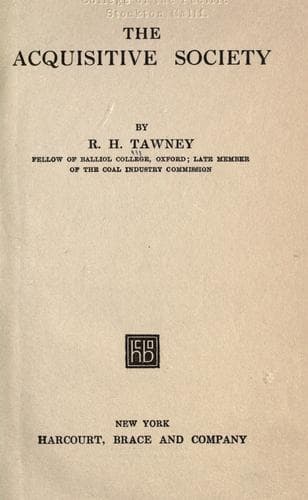
The Acquisitive SocietyTawney, R. H. (Richard Henry)
Philosophy
The Acquisitive Society
Tawney, R. H. (Richard Henry)
Economics; Industries; Social problems
Such societies may be called Acquisitive Societies, because their whole
tendency and interest and preoccupation is to promote the acquisition
of wealth. The {30} appeal of this conception must be powerful, for it
has laid the whole modern world under its spell. Since England first
revealed the possibilities of industrialism, it has gone from strength
to strength, and as industrial civilization invades countries hitherto
remote from it, as Russia and Japan and India and China are drawn into
its orbit, each decade sees a fresh extension of its influence. The
secret of its triumph is obvious. It is an invitation to men to use
the powers with which they have been endowed by nature or society, by
skill or energy or relentless egotism or mere good fortune, without
inquiring whether there is any principle by which their exercise should
be limited. It assumes the social organization which determines the
opportunities which different classes shall in fact possess, and
concentrates attention upon the right of those who possess or can
acquire power to make the fullest use of it for their own
self-advancement. By fixing men's minds, not upon the discharge of
social obligations, which restricts their energy, because it defines
the goal to which it should be directed, but upon the exercise of the
right to pursue their own self-interest, it offers unlimited scope for
the acquisition of riches, and therefore gives free play to one of the
most powerful of human instincts. To the strong it promises unfettered
freedom for the exercise of their strength; to the weak the hope that
they too one day may be strong. Before the eyes of both it suspends a
golden prize, which not all can attain, but for which each may strive,
the enchanting vision of infinite expansion. It assures men that there
are no ends other {31} than their ends, no law other than their
desires, no limit other than that which they think advisable. Thus it
makes the individual the center of his own universe, and dissolves
moral principles into a choice of expediences. And it immensely
simplifies the problems of social life in complex communities. For it
relieves them of the necessity of discriminating between different
types of economic activity and different sources of wealth, between
enterprise and avarice, energy and unscrupulous greed, property which
is legitimate and property which is theft, the just enjoyment of the
fruits of labor and the idle parasitism of birth or fortune, because it
treats all economic activities as standing upon the same level, and
suggests that excess or defect, waste or superfluity, require no
conscious effort of the social will to avert them, but are corrected
almost automatically by the mechanical play of economic forces.
Public-domain text, read in full here on John Shaqi.
Reviews
Reviews
No reviews yet
Be the first to share your thoughts on this work.
Join the Discussion
Join the discussion
Sign in to leave a comment or review.
Sign InorCreate an account