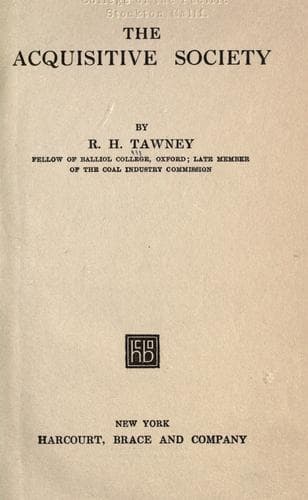
The Acquisitive SocietyTawney, R. H. (Richard Henry)
Philosophy
The Acquisitive Society
Tawney, R. H. (Richard Henry)
Economics; Industries; Social problems
Under the impulse of such ideas men do not become religious or wise or
artistic; for religion and wisdom and art imply the acceptance of
limitations. But they become powerful and rich. They inherit the
earth and change the face of nature, if they do not possess their own
souls; and they have that appearance of freedom which consists in the
absence of obstacles between opportunities for self-advancement and
those whom birth or wealth or talent or good fortune has placed in a
position to seize them. It is not difficult either for individuals or
for societies to achieve their object, if that object be sufficiently
limited and immediate, and if they are not distracted from its {32}
pursuit by other considerations. The temper which dedicates itself to
the cultivation of opportunities, and leaves obligations to take care
of themselves, is set upon an object which is at once simple and
practicable. The eighteenth century defined it. The twentieth century
has very largely attained it. Or, if it has not attained it, it has at
least grasped the possibilities of its attainment. The national output
of wealth per head of population is estimated to have been
approximately $200 in 1914. Unless mankind chooses to continue the
sacrifice of prosperity to the ambitions and terrors of nationalism, it
is possible that by the year 2000 it may be doubled.
{33}
IV
THE NEMESIS OF INDUSTRIALISM
Such happiness is not remote from achievement. In the course of
achieving it, however, the world has been confronted by a group of
unexpected consequences, which are the cause of its _malaise_, as the
obstruction of economic opportunity was the cause of social _malaise_
in the eighteenth century. And these consequences are not, as is often
suggested, accidental mal-adjustments, but flow naturally from its
dominant principle: so that there is a sense in which the cause of its
perplexity is not its failure, but the quality of its success, and its
light itself a kind of darkness. The will to economic power, if it is
sufficiently single-minded, brings riches. But if it is single-minded
it destroys the moral restraints which ought to condition the pursuit
of riches, and therefore also makes the pursuit of riches meaningless.
For what gives meaning to economic activity, as to any other activity
is, as we have said, the purpose to which it is directed. But the
faith upon which our economic civilization reposes, the faith that
riches are not a means but an end, implies that all economic activity
is equally estimable, whether it is subordinated to a social purpose or
not. Hence it divorces gain from service, and justifies rewards for
which no function is performed, or which are out of all proportion to
it. Wealth in modern societies is distributed according to {34}
opportunity; and while opportunity depends partly upon talent and
energy, it depends still more upon birth, social position, access to
education and inherited wealth; in a word, upon property.
Public-domain text, read in full here on John Shaqi.
Reviews
Reviews
No reviews yet
Be the first to share your thoughts on this work.
Join the Discussion
Join the discussion
Sign in to leave a comment or review.
Sign InorCreate an account