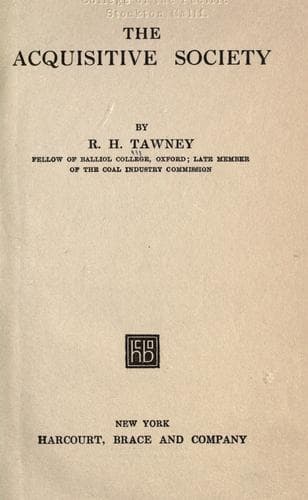
The Acquisitive SocietyTawney, R. H. (Richard Henry)
Philosophy
The Acquisitive Society
Tawney, R. H. (Richard Henry)
Economics; Industries; Social problems
For talent
and energy can create opportunity. But property need only wait for it.
It is the sleeping partner who draws the dividends which the firm
produces, the residuary legatee who always claims his share in the
estate.
Because rewards are divorced from services, so that what is prized most
is not riches obtained in return for labor but riches the economic
origin of which, being regarded as sordid, is concealed, two results
follow. The first is the creation of a class of pensioners upon
industry, who levy toll upon its product, but contribute nothing to its
increase, and who are not merely tolerated, but applauded and admired
and protected with assiduous care, as though the secret of prosperity
resided in them. They are admired because in the absence of any
principle of discrimination between incomes which are payment for
functions and incomes which are not, all incomes, merely because they
represent wealth, stand on the same level of appreciation, and are
estimated solely by their magnitude, so that in all societies which
have accepted industrialism there is an upper layer which claims the
enjoyment of social life, while it repudiates its responsibilities.
The _rentier_ and his ways, how familiar they were in England before
the war! A public school and then club life in Oxford and Cambridge,
and then another club in town; London in June, when London is pleasant,
the moors in August, and pheasants in October, Cannes in {35} December
and hunting in February and March; and a whole world of rising
bourgeoisie eager to imitate them, sedulous to make their expensive
watches keep time with this preposterous calendar!
The second consequence is the degradation of those who labor, but who
do not by their labor command large rewards; that is of the great
majority of mankind. And this degradation follows inevitably from the
refusal of men to give the purpose of industry the first place in their
thought about it. When they do that, when their minds are set upon the
fact that the meaning of industry is the service of man, all who labor
appear to them honorable, because all who labor serve, and the
distinction which separates those who serve from those who merely spend
is so crucial and fundamental as to obliterate all minor distinctions
based on differences of income. But when the criterion of function is
forgotten, the only criterion which remains is that of wealth, and an
Acquisitive Society reverences the possession of wealth, as a
Functional Society would honor, even in the person of the humblest and
most laborious craftsman, the arts of creation.
Public-domain text, read in full here on John Shaqi.
Reviews
Reviews
No reviews yet
Be the first to share your thoughts on this work.
Join the Discussion
Join the discussion
Sign in to leave a comment or review.
Sign InorCreate an account