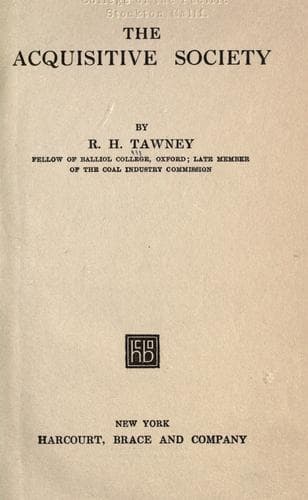
The Acquisitive SocietyTawney, R. H. (Richard Henry)
Philosophy
The Acquisitive Society
Tawney, R. H. (Richard Henry)
Economics; Industries; Social problems
So wealth becomes the foundation of public esteem, and the mass of men
who labor, but who do not acquire wealth, are thought to be vulgar and
meaningless and insignificant compared with the few who acquire wealth
by good fortune, or by the skilful use of economic opportunities. They
come to be regarded, not as the ends for which alone it is worth while
to produce wealth at all, but as the instruments of its {36}
acquisition by a world that declines to be soiled by contact with what
is thought to be the dull and sordid business of labor. They are not
happy, for the reward of all but the very mean is not merely money, but
the esteem of their fellow-men, and they know they are not esteemed, as
soldiers, for example, are esteemed, though it is because they give
their lives to making civilization that there is a civilization which
it is worth while for soldiers to defend. They are not esteemed,
because the admiration of society is directed towards those who get,
not towards those who give; and though workmen give much they get
little. And the _rentiers_ whom they support are not happy; for in
discarding the idea of function, which sets a limit to the acquisition
of riches, they have also discarded the principle which alone give
riches their meaning. Hence unless they can persuade themselves that
to be rich is in itself meritorious, they may bask in social
admiration, but they are unable to esteem themselves. For they have
abolished the principle which makes activity significant, and therefore
estimable. They are, indeed, more truly pitiable than some of those
who envy them. For like the spirits in the Inferno, they are punished
by the attainment of their desires.
Public-domain text, read in full here on John Shaqi.
Reviews
Reviews
No reviews yet
Be the first to share your thoughts on this work.
Join the Discussion
Join the discussion
Sign in to leave a comment or review.
Sign InorCreate an account