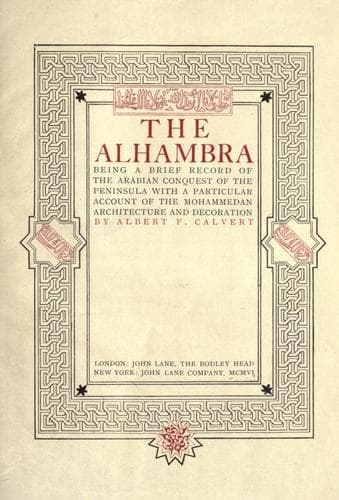
The Alhambra: being a brief record of the Arabian conquest of the Peninsula with a particular account of the Mohammedan architecture and decoration — John Shaqi
The Alhambra: being a brief record of the Arabian conquest of the Peninsula with a particular account of the Mohammedan architecture and decorationCalvert, Albert Frederick
Islamic
The Alhambra: being a brief record of the Arabian conquest of the Peninsula with a particular account of the Mohammedan architecture and decoration
The innumerable sentences abounding everywhere in the Alhambra are so
harmonious and interweaving--producing such cross-lights of poetry and
praise, merging naturally and gracefully when the mind is torpid or
indifferent to them, into mere surface ornament--that they are never out
of place, but present always an unsatiating charm. Once, at least, an
inscription in the Palace has settled a dull controversy respecting the
use of the many small, highly-decorated recesses which are seen in the
apartments. On each side of the ante-room of the Hall of the Ambassadors
is one of these recesses resembling the piscinæ of our cathedrals.
Blundering wise men insistently averred that these niches were used by
suppliants as receptacles for their slippers before entering to an
audience, until an Arabic scholar pointed to an inscription round the
aperture, which reads: “_If anyone approach me complaining of thirst, he
will receive cool and limpid water, sweet and pure._” Any Spaniard ought
to have known that here were the places of the _Alcarraza_, or porous
earthen bottles common to all comers, even as they may now be found in
the halls of some Andalusian gentlemen.
Such a niche and water-vase are represented in this volume at page 77.
“Is the Alhambra,” asks Ford, “a palace of the _Arabian Nights_, or only
a tawdry ruin bedaubed with faded colour? And what of the colour as it
exists? Is it emeraldine or plaited flowers? No, in sober truth, the
colour is dim and faded; buried in some places under white flaky icicles
of whitewash, or blurred and besmirched as a dead butterfly’s wing. Here
and
[Illustration: VARIOUS MOSAICS FROM THE ALHAMBRA.]
there are revived bright scraps of azure, gold, and vermilion; but
generally dull of outline, and dim in low, deep, shadow tone.”
Where the Moorish work is imitated, greens and purples obtrude, to
demonstrate how inferior is modern decorative skill to the genius of the
ancient Arabs. The dados, or low wainscotings, are of square, glazed
tiles, which form a glittering breast-high coat of mail up to the lower
third of the Palace
[Illustration: PANEL ORNAMENT IN THE ALHAMBRA.]
walls. Here the colours are the same as those of the old Majolica ware.
Sometimes these _Azulejo_ tiles, with their low-toned enamel colours,
are formed into pillars, or pave the floors in squares of
_fleurs-de-lis_, or other heraldic emblems. In these dados, colour is
seen in the shade. The Moors wanted shade in a country where the sun is
solid fire--the colours deep, soft, and subdued as in an Arabian carpet.
Public-domain text, read in full here on John Shaqi.
Reviews
Reviews
No reviews yet
Be the first to share your thoughts on this work.
Join the Discussion
Join the discussion
Sign in to leave a comment or review.
Sign InorCreate an account