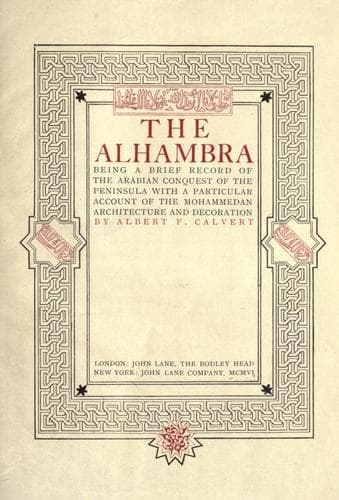
The Alhambra: being a brief record of the Arabian conquest of the Peninsula with a particular account of the Mohammedan architecture and decoration — John Shaqi
The Alhambra: being a brief record of the Arabian conquest of the Peninsula with a particular account of the Mohammedan architecture and decorationCalvert, Albert Frederick
Islamic
The Alhambra: being a brief record of the Arabian conquest of the Peninsula with a particular account of the Mohammedan architecture and decoration
The present pavement of the halls and courts of the Palace is either of
white marble, as in the Hall of The Two Sisters and Hall of the
Abencerrages, or of brick. Seldom, however, does it appear to be the
original flooring, as in many places it is considerably above the
ancient level, concealing the lower part of the Mosaic dados. On the
pavement of one of the alcoves of the Hall of Justice are still to be
seen painted tiles which seem to suggest a style of flooring more in
harmony with the general decoration of the Halls and Courts than either
those of marble or of brick. This deduction has been objected to by
persons conversant with the manners and customs of the Mohammedans, who
contend that it is impossible that these tiles--on which the name of God
is written--should have been trodden under foot. But it should be borne
in mind that the Arabs of Spain allowed themselves considerable laxity
in observing the behests of the Korán--as is evidenced by the fountain
in the Court of Lions, the bas-relief in the Museum of the Palace, and
the paintings in the Hall of Justice.
For the student who desires to pursue exhaustively the history of the
Moors in Spain, there are but two trustworthy authorities--Don Pascual
de Gayángos, the Spanish Orientalist and historian, and Dr. R. Dozy, of
Leyden. Don Pascual’s translation of _Al-makkarí_ has been largely drawn
upon in the compilation of the present volume, as also the “Handbook”
and “Gatherings” of Richard Ford (1845 and onward), which form the bases
of the indispensable Murray’s _Guide_. For the last days of the Moslems
in Spain, Sir William Stirling-Maxwell’s _Don John of Austria_ must be
read. The fascinating volumes of Washington Irving will, of course,
continue to delight so long as the English language endures, and no
better companions can be wished for on the spot where they were written
than his stories of _The Alhambra_ and _The Conquest of Granada_. Mr.
Henry Coppeé’s _History of the Conquest of Spain by the Arab Moors_, in
two volumes, _Boston_ (Mass.), 1881; Miss Charlotte Yonge’s _Christians
and Moors in Spain_; Mr. H. E. Watt’s _Spain from the Moorish Conquest
to the Fall of Granada_; the concise _Rise and Fall of the Muslim Empire
in Spain_, by our fellow-subject, Muhammed Hayat Khan, Lahore, 1897; and
Mr. Stanley Lane-Poole’s _The Moors in Spain_ should be consulted.
ORNAMENT.
However much disguised, the whole ornamentation of the Moors is
constructed geometrically.
[Illustration: FRET.--FIG. 1. FORMED BY THE INTERLACING OF LINES. THE
NUMEROUS FRETS THROUGHOUT THE PALACE ARE FORMED UPON THE TWO PRINCIPLES
EXHIBITED IN THIS AND FOLLOWING DIAGRAM.]
It is probable that the immense variety of Moorish ornaments, which are
formed by the intersection of equi-distant lines, could be traced
through the Arabian to the Greek fret.
Public-domain text, read in full here on John Shaqi.
Reviews
Reviews
No reviews yet
Be the first to share your thoughts on this work.
Join the Discussion
Join the discussion
Sign in to leave a comment or review.
Sign InorCreate an account