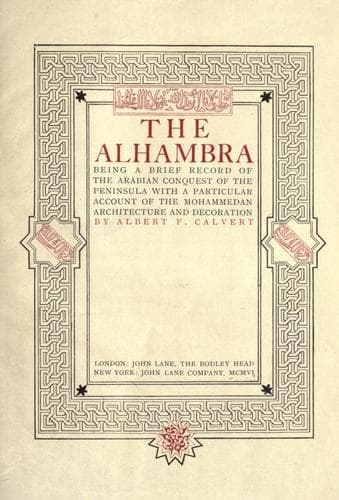
The Alhambra: being a brief record of the Arabian conquest of the Peninsula with a particular account of the Mohammedan architecture and decoration — John Shaqi
The Alhambra: being a brief record of the Arabian conquest of the Peninsula with a particular account of the Mohammedan architecture and decorationCalvert, Albert Frederick
Islamic
The Alhambra: being a brief record of the Arabian conquest of the Peninsula with a particular account of the Mohammedan architecture and decoration
The Moorish system of decoration reached its culminating point in the
ornament of the Alhambra. Owen Jones says: “The Alhambra is at the very
summit of perfection of Moorish art ... every principle which we can
derive from the study of the ornamental art of any other people is not
only ever present here, but was by the Moors more universally and truly
obeyed. We find in the Alhambra the speaking art of the Egyptians, the
natural grace and refinement of the Greeks, the geometrical combination
of the Romans, the Byzantines, and the Arabs.
[Illustration: FRET.--FIG. 2. FORMED BY THE INTERLACING OF LINES.]
The ornament wanted but one charm, which was the peculiar feature of the
Egyptian ornament--symbolism. This, the religion of the Moors forbade.”
The decoration of the Alhambra is peculiarly appropriate--the
circumstances of the people rendered the ornament beautiful for that
reason--when transplanted, though it loses nothing of its loveliness, it
becomes inexpressive.
The Moors ever regarded what architects hold to be the first principle
of architecture--to decorate construction--never to construct
decoration. In Moorish architecture, not only does the decoration arise
naturally from the construction, but the constructive idea is carried
out in every detail of the ornamentation of the surface. A superfluous,
or useless ornament is never found in Moorish decoration; every ornament
arises quietly and naturally from the surface decorated.
[Illustration: PLAN OF GENERAL CONSTRUCTION OF CENTRAL ORNAMENT OF
CEILINGS.]
The general forms were first cared for; these were sub-divided by
general lines; the interstices were then filled in with ornament again
to be sub-divided and enriched for closer inspection. The principle was
carried out with the greatest refinement, and the harmony and beauty of
all Moorish ornamentation derive success from its observance. The
greatest distinction was thus obtained; the detail never interfering
with the general form. When seen at a distance, the main lines strike
the eye; on nearer approach, the detail comes into the composition; upon
yet closer inspection, further detail is seen on the surface of the
ornaments themselves.
To the builders of the Alhambra, harmony of form consisted in the proper
balancing and contrast of the straight, the inclined, and the curved.
[Illustration: SECTION OF THE COLUMNS AND ARCHES OF GENERAL CONSTRUCTION
IN THE PALACE.]
As in colour, there can be no composition in which either of the three
primary colours is wanting, so in form, whether structural or
decorative, there can be no perfect composition in which either of the
three primary figures is lacking; variety and harmony in composition and
design depend on the pre-dominance and subordination of the three.
Public-domain text, read in full here on John Shaqi.
Reviews
Reviews
No reviews yet
Be the first to share your thoughts on this work.
Join the Discussion
Join the discussion
Sign in to leave a comment or review.
Sign InorCreate an account