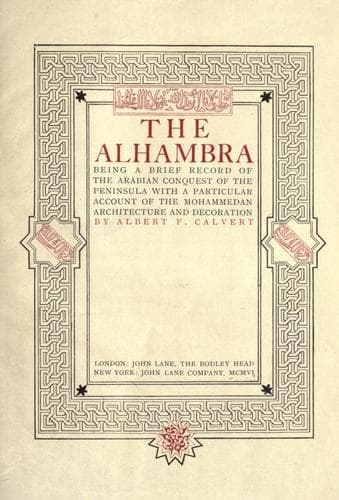
The Alhambra: being a brief record of the Arabian conquest of the Peninsula with a particular account of the Mohammedan architecture and decorationCalvert, Albert Frederick
Islamic
The Alhambra: being a brief record of the Arabian conquest of the Peninsula with a particular account of the Mohammedan architecture and decoration
In his monumental work on the ornamentation of the Alhambra, the late
Owen Jones, who spent many years at Granada in collaboration with his
friend, M. Jules Goury, the eminent French architect, studying the
Palace of the Western Caliphs, furnishes diagrams in support of this
conclusion, which are here reproduced; and, furthermore, says: “In
[Illustration]
surface decoration, any arrangement of forms, as at A., consisting only
of straight lines, is monotonous, and affords but imperfect pleasure;
but, introduce lines which tend to carry the eye towards the angles, as
at B., and you have at once an additional pleasure.
[Illustration]
“Then add lines giving a circular tendency, as at C., and you have now
complete harmony: in this case the square is the leading form or tonic;
the angular and curved are subordinate.
“We may produce the same result in adopting an angular composition, as
at D., add the lines as at E., and we at once correct the tendency to
follow only the angular direction of the inclined lines; but, unite
these by circles as at F., and we have harmony still more nearly
perfect, _i.e._, repose, for the eye has now no longer any want that
could be supplied.”
Still, compositions distributed in equal lines or divisions will be less
beautiful than those which require a greater mental effort to appreciate
them: proportions the most difficult for the eye to detect will be the
most agreeable.
In surface decoration by the Moors, lines flow from a parent stem: every
ornament, however distant, can be traced to its branch and root; they
have the happy art of so adapting the ornament to the surface decorated,
that the ornament as often appears to have suggested the general form as
to have been suggested by it. In all cases we find the foliage flowing
out of a parent stem, and we are never offended, as in modern practice,
by the random introduction of an ornament set down without a reason for
its existence. However irregular the space they have to fill, they
always commence by dividing it into equal areas, and round these trunk
lines they fill in their detail, but invariably return to their parent
stem.
The Moors also followed another principle, that of radiation from the
parent stem, as we may see exemplified in nature by the human hand, or
in a chestnut leaf. When style becomes debased, neither of these laws is
followed; as in Elizabethan ornament, where nothing is continuous,
nothing radiates, all is haphazard.
All junctions of curved lines with curved, or of curved with straight,
should be tangential to each other. The Oriental practice always accords
with this principle. Many of their ornaments are on the principle which
is observable in the lines of a feather and in the articulations of a
leaf; and to this is due that additional charm found in all perfect
ornamentation, which is called “the graceful.”
[Illustration: MISCELLANEOUS ORNAMENT IN THE ALHAMBRA]
Public-domain text, read in full here on John Shaqi.
Reviews
Reviews
No reviews yet
Be the first to share your thoughts on this work.
Join the Discussion
Join the discussion
Sign in to leave a comment or review.
Sign InorCreate an account